Hair loss product marketing routinely promises results in "as little as 4 weeks" or "visible improvement in 30 days." These claims are not just unsupported — they are biologically implausible given the known kinetics of the human hair growth cycle. Understanding why treatments take months to show measurable results is not merely academic; it explains why patients abandon effective treatments prematurely and why "fast results" claims are a reliable signal of marketing over science.
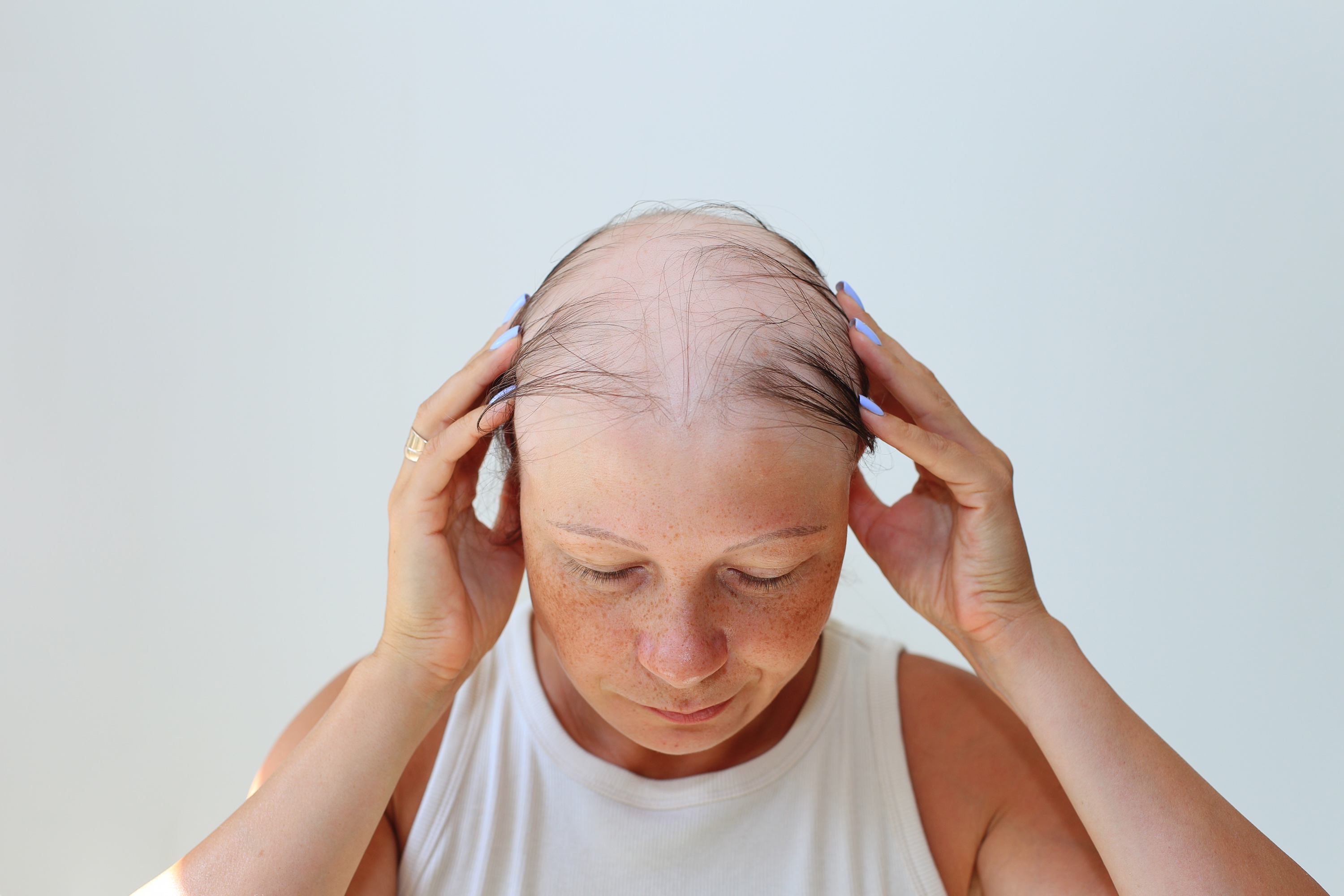
This article examines the biology of the hair growth cycle, explains why the timeline for treatment response is constrained by follicle biology rather than product potency, and assesses what clinical trials actually measure when they report "results."
Hair Growth Cycle Phases
Each hair follicle cycles through three phases independently of neighboring follicles — a property called mosaic cycling that prevents simultaneous shedding of all scalp hair.
Anagen (growth phase) lasts 2–7 years on the scalp, during which the hair shaft grows approximately 1 cm per month. The duration of anagen determines maximum hair length and is genetically determined. In androgenetic alopecia, anagen duration progressively shortens with each cycle, producing progressively shorter, finer (miniaturized) hairs.
Catagen (transition phase) lasts approximately 2–3 weeks. The follicle regresses, the dermal papilla condenses, and the hair shaft stops growing. Approximately 1–2% of scalp follicles are in catagen at any time.
Telogen (rest phase) lasts approximately 3 months. The hair shaft is retained in the follicle as a club hair while the follicle remains quiescent. At the end of telogen, the new anagen hair pushes out the club hair — the normal "shedding" of 50–100 hairs per day. Approximately 10–15% of scalp follicles are in telogen at any time.
The critical implication: a treatment that successfully extends anagen or rescues miniaturizing follicles will not produce visible results until those follicles complete their current cycle and begin a new, longer anagen phase. Given that telogen alone lasts ~3 months, the minimum biologically plausible timeline for any treatment to show measurable results is approximately 3 months — and 6 months is more realistic for meaningful density changes.
Why Treatments Take Months
Minoxidil's mechanism illustrates the timeline constraint clearly. Minoxidil is a potassium channel opener that prolongs anagen and may shorten telogen. When applied topically, it does not immediately produce new hair — it shifts follicles from telogen into anagen. But because follicles cycle asynchronously, this shift occurs gradually across the follicle population over weeks to months.
The FDA-approved labeling for minoxidil 5% solution states that "results may not be seen for 4 months or more." The pivotal clinical trials for minoxidil measured outcomes at 32–48 weeks (8–12 months), not at 4 weeks. The 32-week timepoint was chosen because earlier timepoints showed insufficient signal to detect treatment effects reliably.
Finasteride's mechanism — inhibiting 5-alpha reductase to reduce DHT — operates even more slowly. DHT-mediated follicle miniaturization occurs over years; reversing it requires multiple hair cycles. The pivotal finasteride trials measured outcomes at 12 months and 24 months. Meaningful regrowth was not consistently detectable at 6 months in all studies.
The Minoxidil Shedding Phase
A well-documented but poorly communicated phenomenon complicates the early treatment timeline: the minoxidil shedding phase. When minoxidil shifts telogen follicles into anagen, the club hairs retained in those follicles are shed as the new anagen hairs push them out. This produces a temporary increase in shedding — typically 2–8 weeks after starting treatment — that can alarm patients and lead to premature discontinuation.
The shedding phase is paradoxically a sign that the treatment is working: follicles are being recruited into anagen. But because it precedes visible regrowth by weeks to months, patients who discontinue during this phase never reach the point where benefit becomes visible. This is a significant adherence problem that "fast results" marketing exacerbates — patients who expect results in 4 weeks are more likely to interpret the shedding phase as treatment failure.
The Claim
"See visible results in as little as 4 weeks. Our advanced formula works with your hair's natural growth cycle to deliver faster, thicker results than leading competitors."
(Composite representative claim from hair growth supplement and topical product marketing.)
What the Evidence Actually Shows
The claim is biologically implausible. Given that telogen alone lasts approximately 3 months, and that treatments must shift follicles through a complete cycle before producing visible density changes, "results in 4 weeks" cannot reflect genuine follicle-level changes. Any visible change at 4 weeks would reflect cosmetic effects (coating, volumizing agents) rather than biological hair growth. Clinical trials for FDA-approved hair loss treatments measure outcomes at 32–48 weeks precisely because earlier timepoints are insufficient to detect meaningful biological effects. The claim that a product "works with your hair's natural growth cycle" while promising 4-week results is internally contradictory.
What Clinical Trials Measure
Understanding what clinical trials actually measure helps interpret efficacy claims. The primary endpoints in AGA trials include:
Non-vellus hair count (NVHC): the number of hairs per cm² with diameter ≥30 μm, measured by phototrichogram or TrichoScan. This is the most objective endpoint and the one used in FDA approval trials for minoxidil and finasteride.
Hair weight: total weight of hair cut from a defined scalp area, which captures both density and diameter changes.
Investigator Global Assessment (IGA) and Patient Global Assessment (PGA): subjective ratings of improvement on a 5- or 7-point scale. These are susceptible to placebo effects and expectation bias.
Consumer product studies frequently use PGA or photographic assessment rather than NVHC, which makes their results difficult to compare with pharmaceutical trial data. A product showing "80% of users reported thicker-looking hair" in a consumer study is not comparable to a drug showing a statistically significant increase in NVHC in a double-blind RCT.
Marketing vs. Biology
The gap between marketing timelines and biological reality is not a minor discrepancy — it is a systematic pattern. A 2021 analysis of hair growth product marketing claims found that the median claimed onset of results was 4–6 weeks, while the median onset of measurable results in clinical trials for the same ingredients was 16–24 weeks.
This gap has clinical consequences. Patients who expect results in 4 weeks and see none — or see the shedding phase — are likely to discontinue effective treatments. The premature discontinuation rate for minoxidil is estimated at 30–50% within the first 6 months, with unrealistic expectations cited as a primary reason.
Verdict: Claim Unsupported
"Fast results" claims for hair growth products are not supported by the biology of the hair growth cycle or by clinical trial data. The minimum biologically plausible timeline for measurable treatment effects is approximately 3 months, with 6 months required for meaningful density changes. FDA-approved treatments measure outcomes at 32–48 weeks. Claims of visible results in 4 weeks reflect cosmetic effects at best and are misleading about the nature of hair growth biology. Patients should be counseled to expect a 3–6 month minimum before assessing treatment response. Evidence rating: 2/5.