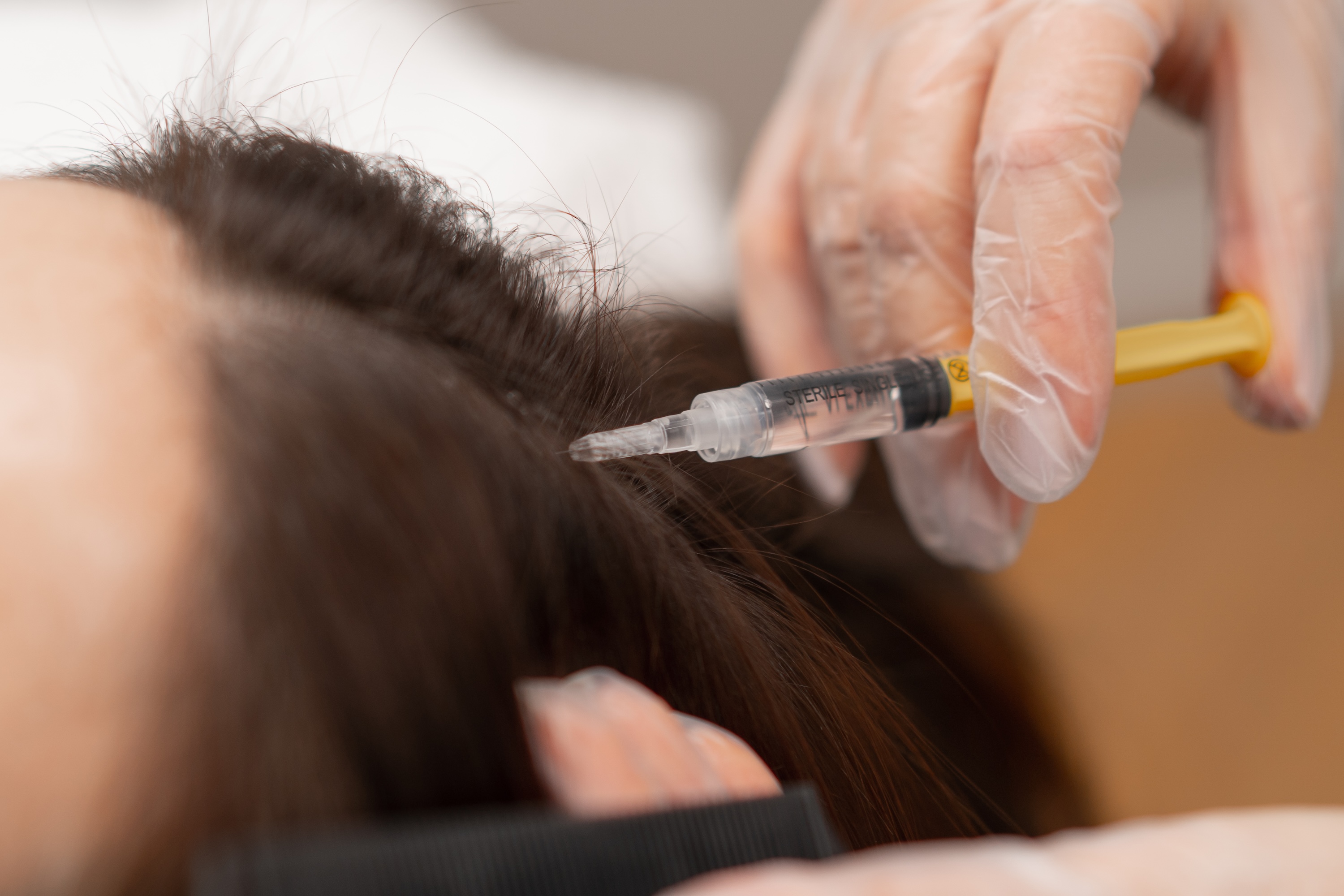
Platelet-rich plasma (PRP) injections for hair loss have become one of the most commonly offered procedures in hair restoration medicine, with costs of $500–$2,000 per session and typical protocols requiring 3–6 initial sessions followed by maintenance injections every 3–6 months. The procedure involves centrifuging the patient's own blood to concentrate platelets and growth factors (PDGF, VEGF, TGF-β, IGF-1), then injecting the concentrate into the scalp at the level of the hair follicles.
The mechanistic rationale is plausible: platelet-derived growth factors stimulate cell proliferation and angiogenesis, and VEGF in particular has been shown to promote hair follicle anagen maintenance in animal models. The clinical evidence, however, is complicated by substantial protocol heterogeneity — PRP preparations vary widely in platelet concentration, activation method, injection technique, and treatment frequency, making cross-study comparisons difficult and limiting the generalizability of any individual trial.
This analysis reviews the RCT evidence for PRP in androgenetic alopecia, examines the protocol variability problem, and assesses what the evidence supports for clinical practice.
The RCT Evidence: Generally Positive but Heterogeneous
The RCT evidence for PRP in androgenetic alopecia is generally positive but limited by small sample sizes and protocol heterogeneity. A 2019 systematic review and meta-analysis by Gupta and Carviel identified 19 RCTs of PRP for AGA, finding a significant pooled effect on hair density (mean increase of 33.6 hairs/cm² versus placebo) and hair thickness. The majority of included trials showed statistically significant improvements in hair count versus placebo or baseline.
However, the review noted substantial heterogeneity (I² = 87%) across studies — meaning the results varied widely between trials in ways that cannot be explained by chance alone. This heterogeneity likely reflects the protocol variability: different PRP preparations, different injection techniques, and different patient populations produce different results. The pooled effect size, while positive, should be interpreted cautiously given this heterogeneity.
The most methodologically rigorous trial in the literature is a 2017 double-blind RCT by Gentile and colleagues (n=23) using a split-scalp design (PRP on one half, placebo on the other), which found significant increases in hair count and thickness on the PRP-treated side at 3 months. The split-scalp design controls for individual variation, but the small sample size limits generalizability.
The Claim
"PRP hair restoration is clinically proven to regrow hair — using your body's own growth factors to naturally stimulate dormant follicles and reverse thinning. Results visible in 3 months, with long-lasting effects."
(Composite representative claim reflecting PRP hair restoration clinic marketing.)
What the Evidence Actually Shows
The "clinically proven" claim is partially supported — multiple RCTs show significant improvements in hair count versus placebo, and a meta-analysis supports a pooled positive effect. However, the evidence quality is limited by small sample sizes, protocol heterogeneity, and the absence of standardized PRP preparation methods that would allow results to be generalized across clinical practices.
The "long-lasting effects" claim is not well-supported. The majority of PRP trials have follow-up periods of 3–6 months. Long-term durability data (beyond 12 months) are limited, and the maintenance injection requirement (every 3–6 months in most protocols) suggests that the effects are not permanent. The "dormant follicles" framing implies that PRP can reactivate follicles that have been miniaturized for years — the evidence does not support this for advanced AGA.
Comparison to established treatments is important context. The effect sizes in PRP trials (mean +33.6 hairs/cm²) are comparable to or smaller than those reported for topical minoxidil 5% in similar populations. PRP is substantially more expensive and invasive than minoxidil. The evidence does not support PRP as a superior alternative to established pharmacological treatments; it may be a useful adjunct.
Protocol Standardization: The Key Evidence Gap
The primary barrier to interpreting the PRP evidence base is protocol heterogeneity. PRP preparations vary in platelet concentration (2–8× baseline), activation method (thrombin, calcium chloride, or no activation), injection depth (intradermal versus subdermal), injection volume, session frequency (monthly versus every 3 months), and number of sessions. Without standardized protocols, it is impossible to know which PRP preparation and technique produces the results reported in any given trial.
This heterogeneity also means that the PRP offered at any given clinic may not correspond to the protocol used in the positive trials. Patients considering PRP should ask about the specific preparation method and protocol used, and compare it to the published evidence.
Verdict: Partially Supported
The evidence for PRP in androgenetic alopecia is positive but limited. Multiple RCTs show significant improvements in hair count versus placebo, and a meta-analysis supports a pooled positive effect. The evidence quality is limited by small sample sizes, substantial protocol heterogeneity, and short follow-up durations. Effect sizes are comparable to topical minoxidil at substantially higher cost and invasiveness. PRP is a reasonable adjunct for patients who have not responded adequately to pharmacological treatments; it is not established as a superior alternative. Evidence rating: 3/5.