Walk the skincare aisle of any major pharmacy — or scroll through the sponsored results on any beauty retailer's site — and the word concentration appears everywhere. "1% retinol." "Clinical-strength 0.5%." "Advanced formula: 2× more retinol per drop." The implication is unmistakable: more is better. Higher concentration means harder-working science. The number on the label is the product.
The global retinol market hit roughly $1.1 billion in 2024 and shows no sign of retreating. In this environment, concentration has become the primary marketing lever — the one differentiating claim that requires no clinical trial, no regulatory clearance, and no consumer education to land. A brand can reformulate overnight, triple the listed retinol percentage, and call it a "professional-grade upgrade."
What the marketing copy rarely includes is the rest of the biochemistry: that retinol is a pro-drug, not the active molecule; that its conversion to the active form depends on enzymes in your skin, not on the number printed on the bottle; and that the dose-response curve for retinoids, as with most topical bioactives, is decidedly non-linear. The randomized controlled trial literature — which is thinner than the marketing spend would suggest — tells a more equivocal story.
What Retinol Actually Is
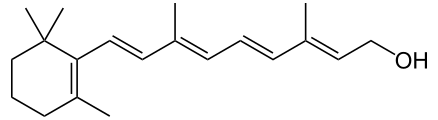
Retinol is a form of Vitamin A — specifically, the alcohol form (all-trans-retinol). It is not the molecule that produces the well-documented effects on collagen synthesis, epidermal turnover, and melanin distribution. That molecule is retinoic acid, sold by prescription as tretinoin (Retin-A and generics).
The conversion pathway in skin runs: retinol → retinaldehyde (retinal) → retinoic acid. Each step is enzymatically mediated. Retinol is first oxidized to retinaldehyde by alcohol dehydrogenases and short-chain dehydrogenases/reductases (SDRs) in keratinocytes. Retinaldehyde is then irreversibly oxidized to retinoic acid by retinaldehyde dehydrogenases (RALDHs). The resulting retinoic acid binds to retinoic acid receptors (RARα, RARβ, RARγ) and retinoid X receptors (RXRs), which act as ligand-activated transcription factors, directly regulating an estimated 400–500 target genes involved in cell differentiation, proliferation, and extracellular matrix remodeling.
This multi-step enzymatic conversion has two critical implications for interpreting concentration claims. First, the enzymatic machinery is rate-limiting: the skin has a finite capacity to oxidize retinol. Beyond a certain concentration gradient, additional retinol does not translate into proportionally more retinoic acid; instead it may simply accumulate, degrade, or sit unactivated in the stratum corneum. Second, the conversion efficiency varies between individuals based on enzyme expression levels, skin barrier integrity, and prior retinoid exposure — meaning that the same labeled concentration may generate meaningfully different tissue concentrations of active retinoic acid across patients.
"The enzymatic conversion rate is the real ceiling. Beyond a certain threshold, additional retinol doesn't translate to proportionally more retinoic acid — the pathway saturates."
The marketing conflation of retinol with tretinoin is not merely imprecision — it is the central rhetorical move of the category. Tretinoin delivers retinoic acid directly to the receptor; no conversion step required. Retinol must be converted, which introduces variability at every enzymatic checkpoint. This is why the same clinical endpoints achieved with 0.025% tretinoin require approximately 0.3–1% retinol — a roughly tenfold to fortyfold concentration difference — and even then, the comparability is imperfect.
The Claim: Higher Concentration = Greater Efficacy

The Claim
"Higher retinol concentration delivers greater anti-aging efficacy. Our 1% retinol formula provides maximum-strength results — visibly reducing fine lines, improving skin texture, and stimulating collagen production more effectively than lower-concentration alternatives."
(Composite representative claim; reflects language present across multiple mass-market and prestige retinol products.)
What the Evidence Actually Shows
The foundational retinoid efficacy trial — Kang et al. (1995) in the New England Journal of Medicine — used 0.1% tretinoin, not retinol, applied over 40 weeks. It demonstrated statistically significant improvement in fine wrinkling, irregular pigmentation, and sallowness, with histological confirmation of collagen synthesis increases and epidermal thickening. This remains the best-controlled evidence for retinoid anti-aging efficacy; it is not evidence for OTC retinol concentration superiority.
Draelos et al. (2010) conducted a 24-week, double-blind, placebo-controlled trial of a cosmetic retinol 0.1% formulation in photoaged subjects. Significant improvements in fine wrinkle depth and tactile roughness were observed relative to vehicle control. Importantly, the study used a stabilized encapsulated delivery system — not raw retinol in a standard emulsion — which complicates generalization to any 0.1% product on the shelf.
Mukherjee et al.'s systematic review (Journal of Clinical and Aesthetic Dermatology, 2006) examined retinoid use across multiple skin conditions and concentrations. The review found that the dose-response relationship for retinoids is real but saturates: efficacy gains above 0.3–0.5% OTC retinol are modest, while irritation — erythema, peeling, dryness — increases substantially and non-linearly. At higher concentrations, the primary clinical challenge shifts from "is this effective enough?" to "will the patient tolerate it long enough to see results?"
Critically, there are very few published head-to-head RCTs comparing OTC retinol at, say, 0.3% vs. 0.5% vs. 1.0% in the same vehicle, with the same delivery system, over adequate follow-up. The concentration arms race in marketing has substantially outpaced the comparative clinical trial literature.
The Penetration Problem

A concentration listed on a product label describes what is in the bottle. It does not describe what reaches the viable epidermis — the layer where the enzymatic conversion machinery actually resides. Between label and receptor, retinol faces a formidable set of barriers.
Vehicle matters enormously. Retinol's bioavailability is not simply a function of its percentage in formulation. A hydrophilic (water-based) gel vehicle will deliver retinol to the stratum corneum differently than an anhydrous oil or a lipid-rich emollient base. Retinol is a fat-soluble molecule; vehicles that enhance penetration through the lipid-rich stratum corneum bilayers — such as propylene glycol-based systems or specialized liposomal encapsulants — can meaningfully increase dermal delivery even at lower labeled concentrations. An encapsulated 0.3% retinol may outperform a destabilized 1.0% retinol in an oxidation-prone emulsion.
"An encapsulated 0.3% retinol in a well-designed delivery system can outperform an unstabilized 1% formulation. Concentration on the label tells you almost nothing about what reaches the receptor."
Stability and degradation. Retinol is notably unstable. It is sensitive to UV light, atmospheric oxygen, and pH extremes. Industry formulation data — though rarely published in peer-reviewed literature — suggest that poorly preserved retinol products can lose significant potency within weeks of opening, and that stated concentrations at the time of manufacture may not reflect in-use concentrations by the time a consumer applies the product. The "1% retinol" claim is a manufacturing specification, not a delivery guarantee.
Skin barrier heterogeneity. Transepidermal penetration varies substantially by anatomical site, individual barrier integrity, age, and ambient conditions. Subjects with compromised skin barriers — through atopic dermatitis, excessive cleansing, or prior irritant exposure — may paradoxically absorb more retinol (and suffer more irritation), while subjects with intact, thickened barriers may absorb far less regardless of the labeled concentration. No label can account for this variance.
pH sensitivity. Retinol is most stable at slightly acidic pH (around 5.0–6.0). Products formulated at pH outside this range — or combined with acids (AHAs, BHAs, vitamin C derivatives) at low pH — may accelerate retinol oxidation, reducing effective concentration at the point of application, irrespective of what the label states.
What the Trials Actually Show
The table below summarizes key trials bearing on OTC retinol and prescription tretinoin efficacy, with particular attention to concentration and vehicle:
| Study | Agent / Concentration | Vehicle / Delivery | Duration | Primary Endpoint(s) | Result |
|---|---|---|---|---|---|
| Kang et al., NEJM 1995 | Tretinoin 0.1% | Standard cream | 40 weeks | Fine wrinkling, pigmentation, collagen (biopsy) | Significant improvement vs. vehicle; histological collagen increase confirmed |
| Griffiths et al., Arch Dermatol 1995 | Tretinoin 0.025%, 0.05%, 0.1% | Cream | 24 weeks | Wrinkle improvement, tolerability | All three concentrations showed similar efficacy; irritation increased markedly at 0.1% |
| Draelos et al., J Cosmet Dermatol 2010 | OTC Retinol 0.1% | Stabilized encapsulated | 24 weeks | Fine wrinkle depth, tactile roughness | Significant improvement vs. vehicle; effect size smaller than prescription retinoid data |
| Mukherjee et al., J Clin Aesthet Dermatol 2006 | Retinoids (multiple forms, multiple concentrations) | Systematic review | N/A | Anti-aging efficacy, safety across conditions | Dose-response relationship confirmed but non-linear; tolerability becomes limiting factor above mid-range OTC concentrations |
The Griffiths et al. (1995) concentration comparison trial is perhaps the most instructive for the central question here. Across the 0.025%, 0.05%, and 0.1% tretinoin arms, efficacy — measured by wrinkle improvement, roughness reduction, and global photodamage scores — was statistically similar. The differences between concentrations were not clinically meaningful. What was meaningfully different was the tolerability profile: the 0.1% arm produced significantly more erythema, peeling, and subject-reported discomfort. The implication is that for tretinoin, the effective therapeutic window is narrower than the concentration range marketed, and the ceiling is lower.
For OTC retinol, the picture is more complicated because the literature is thinner and less homogeneous. The consensus of available data suggests that OTC retinol at 0.3%–1% produces measurable anti-aging effects — but that effects at 1% are not dramatically greater than at 0.3%, while the irritation burden at 1% is meaningfully higher, particularly in patients with sensitive skin or on concurrent actives (AHAs, niacinamide at high concentrations, physical exfoliants). Meanwhile, even a well-formulated 1% OTC retinol remains roughly 10–20× less potent than prescription 0.025%–0.05% tretinoin at the receptor level — a fact that consumer-facing "clinical-strength" language consistently obscures.
Verdict & Clinical Implications
Verdict: Partially Supported
The claim that higher OTC retinol concentration reliably delivers greater anti-aging efficacy is partially supported. The dose-response relationship is real: retinol at 0.3%–1% produces meaningful photoaging improvements relative to vehicle, and some concentration gradient is necessary. However, the relationship is non-linear and saturates well within the OTC concentration range. Above approximately 0.3–0.5%, tolerability becomes the primary limiting clinical factor, not the efficacy ceiling. Vehicle composition, formulation stability, and pH matter as much as — and in poorly manufactured products, more than — the labeled concentration. Head-to-head OTC retinol concentration comparisons using matched vehicles remain scarce in the peer-reviewed literature, limiting the strength of any definitive claim.
For clinicians advising patients on retinoid selection, several practical points follow from the evidence:
Prescription tretinoin remains the gold standard. The evidence base for tretinoin at 0.025%–0.1% — including histological endpoint data — is substantially stronger and more consistent than the OTC retinol literature. For patients who can tolerate it, even low-concentration tretinoin (0.025%) likely outperforms the highest available OTC retinol concentrations in a comparable vehicle. Tolerability titration (alternate-night application, buffer with moisturizer) extends access across skin types.
For OTC retinol, formulation quality matters more than concentration number. Patients should be directed toward products with documented stability (airtight or opaque packaging, nitrogen-blanketed formulations), credible delivery systems (encapsulated, slow-release microspheres, or anhydrous vehicles), and evidence of pH optimization. A "0.3% retinol" in a stabilized, well-penetrating formulation is likely to outperform a "1.0% retinol" in an unstabilized, oxidation-prone emulsion — and will do so with substantially less irritation.
Encapsulated and slow-release retinol formats merit preference. Microencapsulated retinol stabilizes the molecule during storage, controls the rate of release into the skin, and appears to reduce the irritation burden without proportionally reducing efficacy. This is one area where formulation technology plausibly moves the needle in ways that raw concentration numbers do not.
Evidence rating: 3 / 5. Multiple randomized controlled trials support retinoid efficacy in photoaging, and the mechanistic picture is well-established. The rating is constrained by the scarcity of head-to-head OTC retinol concentration comparisons using matched vehicles, heterogeneous endpoints across studies, and the commercial nature of much of the industry-sponsored literature. The dose-response saturation finding is consistent across available data, but has not been definitively characterized across the full 0.1%–2.0% OTC range in a single high-powered, independently conducted trial.