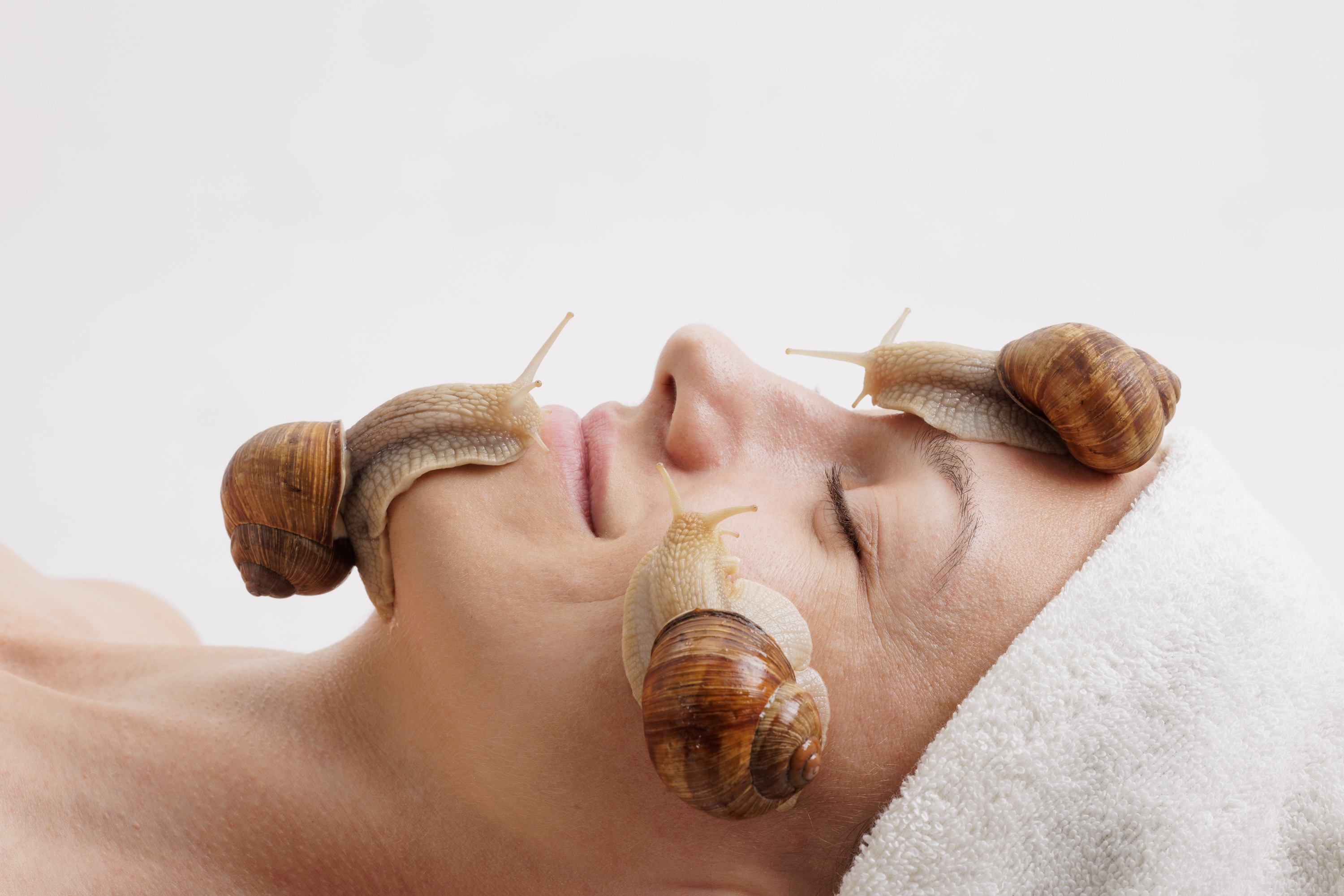
Few ingredients have made the jump from novelty to routine staple as fast as snail mucin. The category is anchored by a single product — COSRX’s Advanced Snail 96 Mucin Power Essence, which headlines a “96% snail secretion filtrate” formula — and has been amplified by a steady stream of “glass skin” before-and-afters. The pitch is that a substance snails produce to protect and repair their own bodies can do something similar for human skin: deep hydration, barrier repair, fading of scars and fine lines.
Snail mucin is not a marketing invention. It is a genuinely complex biological material, and it has been studied in humans, which already puts it ahead of many viral ingredients. But the trials are small, several are funded by the companies selling the product, and the endpoints that improved are not always the ones the marketing leans on. The question worth asking is the usual one: what does the evidence actually show, and where does the claim run ahead of it?
What Snail Mucin Is and How It’s Made
Snail secretion filtrate (SSF), also called snail slime or mucin, is the mucus secreted by land snails, most commonly Cornu aspersum (formerly Helix aspersa or Cryptomphalus aspersa), the common garden snail. The “filtrate” part matters: raw mucus is filtered, centrifuged, and processed into a cosmetic-grade ingredient rather than used directly.
A 2025 review in the Journal of Cosmetic Dermatology catalogs the components that give SSF its plausible activity:
- Glycoproteins — large sugar-protein molecules linked to fibroblast activity and collagen production in laboratory studies.
- Hyaluronic acid and glycosaminoglycans — humectants that bind water and support the skin’s extracellular matrix.
- Glycolic acid — a mild alpha-hydroxy acid associated with gentle exfoliation and cell turnover.
- Allantoin — a soothing agent that promotes cell proliferation and is independently used in wound-care and barrier products.
- Zinc, trace minerals, and antimicrobial peptides — proposed to contribute mild antibacterial and repair effects.
Several of these have been quantified analytically; allantoin and glycolic acid content in snail mucus has been measured by HPLC-UV, and the distinct secretions snails produce have been characterized at the proteomic level (Nature Communications, 2023). This is the strongest part of the story: SSF demonstrably contains ingredients with independent evidence behind them. That is also the catch — hyaluronic acid, glycolic acid, and allantoin are all available in standalone products at known concentrations.
Composition is not fixed. The mucus profile varies with the snail’s diet, breeding, and how the secretion is collected. Harvesting ranges from non-lethal “stimulated production” methods (snails crawling over mesh, gentle mechanical or acid stimulation) to lethal extraction. This variability means “snail mucin” is not a standardized active the way a defined percentage of niacinamide or ascorbic acid is.
What the Marketing Claims
The COSRX essence is marketed for “intense hydration,” repair of dull and damaged skin, improved texture and elasticity, and the fading of fine lines — with the 96% snail secretion filtrate figure doing most of the persuasive work. The broader K-beauty positioning centers the “glass skin” aesthetic: a dewy, translucent, poreless finish. Across other brands, the claims extend further — acne-scar fading, wound-like “healing,” and barrier restoration.
Two things are worth separating here. A high percentage of an ingredient tells you about concentration, not about efficacy or the potency of the active fraction within it. And “repair” and “healing” are doing a lot of work: in cosmetics they describe a cosmetic feel and appearance, not the clinical wound healing the words imply.
The Claim
“96% snail mucin deeply hydrates, repairs the skin barrier, fades scars and fine lines, and gives you glass skin.”
(Composite representative claim; reflects COSRX and broader K-beauty snail-mucin marketing language.)
What the Clinical Evidence Actually Shows
Two human studies anchor the evidence base, and both are worth reading closely because the details temper the enthusiasm.
The first is Fabi et al. (2013), a two-center, double-blind, randomized, split-face trial in the Journal of Drugs in Dermatology. Twenty-five subjects with moderate-to-severe facial photodamage applied a Cryptomphalus aspersa secretion product to one side of the face and placebo to the other for 12 weeks. The active side showed statistically significant improvement in periocular fine lines (P=.03) and texture — but no significant difference in overall skin quality. The product tested was a commercial SCA-based line, so the study is industry-linked, and n=25 is small.
The second is Lim et al. (2020) in the Journal of Clinical and Aesthetic Dermatology: a double-blind randomized trial of 50 women aged 45–65 (30 on an SSF-plus-snail-egg-extract regimen, 20 on vehicle) over three months. The active group showed significantly greater improvements in water loss through the skin (TEWL, p=.026), firmness (p=.005), elasticity (p=.024), and roughness (p=.002). But the headline anti-aging endpoint undercuts the marketing: fine lines and wrinkles improved in both groups, with no significant difference between them. The study was funded by Cantabria Labs, with one author employed by the company and another on its advisory board.
For wound healing — the claim most often implied by “repair” language — the human evidence largely is not there. The supporting literature is dominated by in vitro and animal work, and no large human randomized trial establishes that topical snail mucin heals wounds or fades established scars. Acne-scar fading and the “glass skin” transformation are marketing claims without controlled trial support.
| Claim | Evidence Level | What the Data Show |
|---|---|---|
| Hydration / reduced water loss | Moderate | Significant TEWL improvement in a small funded RCT; consistent with known humectant content |
| Firmness & elasticity | Moderate | Significant between-group improvement (Lim 2020), small industry-funded sample |
| Skin texture / roughness | Moderate | Improved in both anchor trials |
| Fine lines / wrinkles | Weak | Periocular benefit in one trial; no between-group difference in the other |
| Scar fading / wound healing | Very weak | Preclinical only; no confirmed human RCT |
| “Glass skin” transformation | None | Marketing claim; not a measurable clinical endpoint |
What the Evidence Actually Shows
Snail mucin is a legitimate hydrating, texture-improving cosmetic ingredient, and the two anchor trials show real (if modest) benefits for hydration, firmness, elasticity, and roughness. Both trials are small and industry-funded, and the anti-wrinkle claim is the weakest part of the evidence — in the larger trial, wrinkles improved just as much in the placebo group. The barrier-repair and “healing” framing outruns the human data. Much of what SSF delivers is attributable to well-understood components (hyaluronic acid, glycolic acid, allantoin) that are also available in standardized standalone products.
Safety, Ethics, and Regulatory Status
In the US, snail mucin is regulated as a cosmetic ingredient, which means no pre-market efficacy approval is required — brands that make structural “healing” claims risk crossing into drug territory, but the ingredient itself is not vetted by the FDA for the benefits advertised. It is generally well tolerated, but it is an animal-derived protein, and allergic reactions are possible, particularly in people sensitive to mollusks or shellfish. A patch test before first facial use is the sensible precaution.
There is also an ethics dimension the marketing rarely addresses. Snail mucin is not vegan, and harvesting methods vary widely in how humane they are, from low-stress mesh collection to lethal extraction. Brands increasingly advertise “cruelty-free” sourcing, but there is no universal standard, and product quality is inconsistent across the category — a point raised in National Geographic’s 2024 review, which quoted dermatologists noting that larger clinical trials are still needed and a biochemist observing that the specific active molecules have not been isolated.
Verdict: Partially Supported
Snail mucin earns its place as a competent hydrating and texture-smoothing ingredient, backed by two human trials showing real improvements in hydration, firmness, elasticity, and roughness. It loses points because those trials are small and industry-funded, the flagship anti-wrinkle claim is not supported over placebo, and the repair/healing and scar-fading claims rest on preclinical work rather than human evidence. Its measurable benefits also overlap heavily with cheaper, standardized ingredients. A pleasant, low-risk essence — not the regenerative hero the virality implies. Evidence rating: 3/5.
What This Means for Consumers
If you already enjoy a snail-mucin essence, there is no evidence reason to stop. It is a well-tolerated humectant that genuinely improves hydration and skin feel for many people, and the trials support modest texture and firmness benefits. Layered under a moisturizer and sunscreen, it is a reasonable, if optional, step.
What it is not is a scar treatment, a wrinkle eraser, or a barrier-repair breakthrough. If your goals are anti-aging or acne-scar improvement, ingredients with stronger and more consistent evidence — topical retinoids for photoaging and texture, defined-concentration hyaluronic acid for hydration — will do more, at known doses. Snail mucin can complement those, but it does not replace them.
On the “96%” figure: treat it as a marketing anchor, not an efficacy metric. A high percentage of a variable, loosely standardized filtrate does not tell you how much of the active fraction you are getting, and no independent data ties that specific number to better outcomes. Buy snail mucin because you like how it feels and it fits your routine, not because you expect it to transform your skin.
References & Further Reading
- Fabi, S. G., Cohen, J. L., Peterson, J. D., Kiripolsky, M. G., & Goldman, M. P. (2013). The Effects of Filtrate of the Secretion of the Cryptomphalus aspersa on Photoaged Skin. Journal of Drugs in Dermatology, 12(4), 453–457.
- Lim, V. Z., Yong, A. A., Tan, W. P. M., Zhao, X., Vitale, M., & Goh, C. L. (2020). Efficacy and Safety of a New Cosmeceutical Regimen Based on the Combination of Snail Secretion Filtrate and Snail Egg Extract. Journal of Clinical and Aesthetic Dermatology, 13(3), 31–36.
- Rashad, M., Sampò, S., Cataldi, A., & Zara, S. (2025). From Nature to Nurture: The Science and Applications of Snail Slime in Health and Beauty. Journal of Cosmetic Dermatology, 24(2), e70002.
- Comparative mucomic analysis of three functionally distinct Cornu aspersum secretions. (2023). Nature Communications.
- Composition variability of snail mucus with diet and collection. (2024). Scientific Reports.
- Simultaneous determination of allantoin and glycolic acid in snail mucus (HPLC-UV). (2013). Journal of Pharmaceutical and Biomedical Analysis (via ScienceDirect).
- Ferrari, O. (2024, January 8). Snail mucus is a skin care phenomenon—but does it really work? National Geographic.
- COSRX Advanced Snail 96 Mucin Power Essence (manufacturer product page).
- Healthline. Snail Mucin: Benefits and Uses for Skin.