
Thesis launched in 2017 with a premise that distinguished it from the broader nootropic market: rather than selling a single "smart drug" formula, the company would offer four distinct blends and use a customer-completed assessment to recommend which two or three a given person should try first. The framing positioned Thesis as a personalization platform — closer in spirit to a wellness-tech company than a supplement brand — and helped justify a $119-per-month subscription price that sits well above drugstore-tier nootropics.
The four blends are Clarity, Energy, Logic, and Motivation. Each contains seven to nine ingredients, several of which appear across multiple blends in different proportions. Thesis discloses the ingredient list and individual ingredient doses for each blend on its product pages — a meaningful step above the "proprietary blend" opacity that characterizes much of the supplement market — and publishes a starter-kit recommendation algorithm that maps survey responses to suggested blends.
This product breakdown evaluates Thesis on the criteria that matter for a cognitive supplement: dose disclosure, per-ingredient evidence quality, evidence for the blends as combinations, and the regulatory framework that governs how these claims can be made. The honest framing is that Thesis has done several things meaningfully better than its competitors and several things that the supplement category broadly has not done at all.
The Thesis Model: Personalization as a Product
The Thesis purchase flow begins with an online assessment — roughly fifteen questions covering self-reported energy, focus, mood, sleep quality, and cognitive goals. The assessment outputs a recommended starter kit: typically four blends shipped in a one-month trial pack, each labeled with the days the customer is meant to try it. After the trial month, customers select the two or three blends that worked best and continue on subscription.
The personalization framing is the core marketing differentiator, but it is worth being precise about what the algorithm does and does not do. The Thesis assessment is not a clinical instrument. It is not validated against any cognitive performance benchmark, it does not produce a diagnosis, and it does not match individuals to ingredients based on biomarker, genotype, or pharmacokinetic data. It is a marketing funnel that segments customers into product categories — focus-seekers, energy-seekers, motivation-seekers — and recommends blends accordingly. This is a reasonable user-experience design. It is not personalized medicine.
The starter-kit-then-subscription model also has a structural effect on the evidence question: customers self-select the blends that "worked" for them based on subjective experience over a few-day trial. This is the textbook setup for placebo-driven attribution. Caffeine, which appears in the Energy and Clarity blends, produces acute subjective effects within thirty minutes. The other ingredients, whose evidence base for cognitive effects requires weeks of daily administration, do not. A customer who reports that "Energy worked best" within a five-day trial is most likely reporting a caffeine response.
What's Actually in the Blends
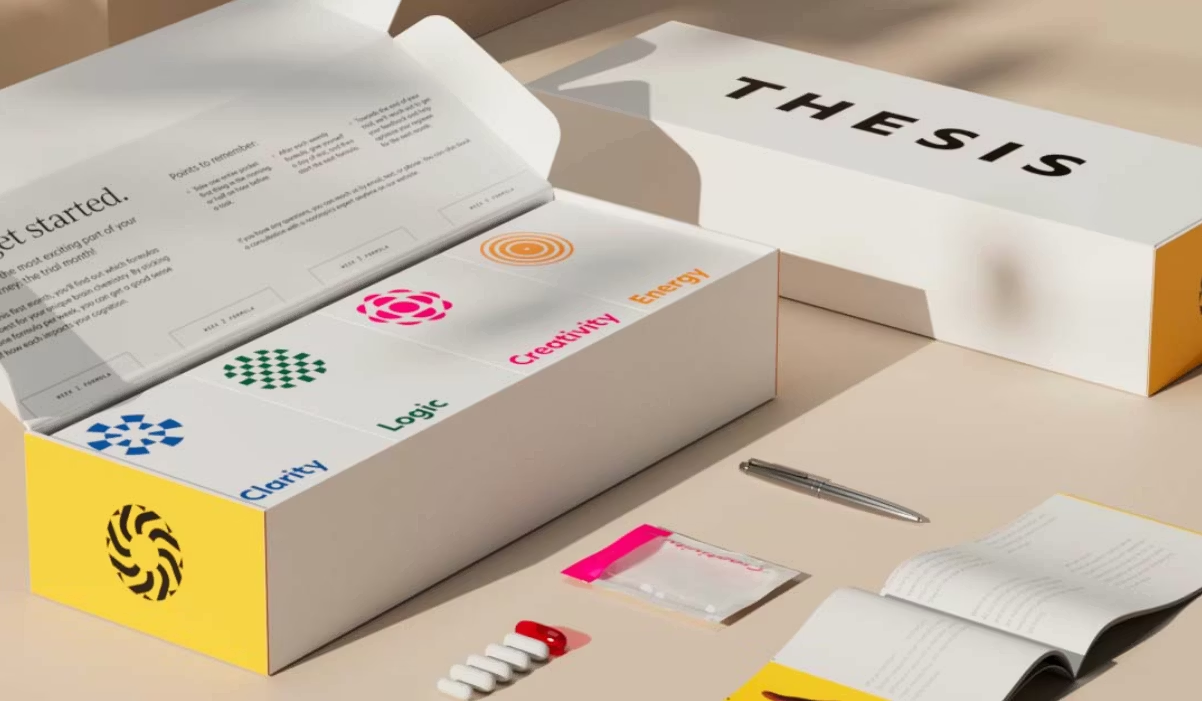
Thesis publishes the full ingredient list and per-ingredient dose for each blend on its product pages, which puts it ahead of competitors that hide doses behind "proprietary blend" labels. The dosing transparency allows for ingredient-by-ingredient evidence evaluation in a way that proprietary-blend products do not. As of May 2026, the four blends contain the following primary actives.
Clarity contains 7,8-dihydroxyflavone, alpha-GPC, epicatechin, lion's mane extract, sabroxy (oroxylin A), and camellia sinensis (which contributes both caffeine and L-theanine). The blend is positioned for verbal recall, decision-making, and cognitive flexibility. Energy contains TeaCrine (theacrine), Dynamine (methylliberine), choline (citicoline), NAD+ precursors, mango leaf extract (Zynamite), N-acetyl-L-tyrosine, and caffeine. It is positioned for sustained alertness and physical endurance. Logic contains TAU (a synthetic version of triacetyluridine), magnesium L-threonate, phosphatidylserine, ginkgo biloba, theobromine, and an Indian gooseberry extract. It is positioned for analytical thinking and memory consolidation. Motivation contains L-phenylalanine, dopa mucuna (mucuna pruriens, a source of L-dopa), forskolin, ashwagandha (KSM-66), and caffeine. It is positioned for mood, drive, and goal pursuit.
Across the four blends, the ingredient list spans three categories that map to very different evidence bases: well-studied acute stimulants (caffeine, theanine, theobromine, the various caffeine-derivative xanthines like theacrine and methylliberine); botanical adaptogens with moderate evidence (ashwagandha, ginkgo biloba, lion's mane); and preclinical or small-trial ingredients (sabroxy, 7,8-dihydroxyflavone, epicatechin, TAU, sabroxy-paired oroxylin A, mango leaf extract). The evidence quality is wildly uneven within each blend.
Per-Ingredient Evidence: What Holds Up
The strongest-evidence ingredients across the Thesis line are generally the most pedestrian. Caffeine has the largest evidence base of any cognitive ingredient on Earth — the acute attention, reaction-time, and alertness benefits are well-replicated and supported by Cochrane-level evidence. L-theanine in combination with caffeine has consistent evidence (Owen 2008, Haskell 2008, multiple replications) for improved attention and reduced jitter compared to caffeine alone. The caffeine-theanine combination at roughly 100 mg / 200 mg is one of the most reliably-supported cognitive interventions in the supplement literature. Thesis's Clarity and Energy blends use this combination at appropriate doses.
Ashwagandha (KSM-66 standardized extract, used in Motivation) has accumulated meaningful RCT evidence for stress reduction and anxiolytic effects, including a 2019 systematic review by Pratte and colleagues in the Journal of Alternative and Complementary Medicine. The cognitive performance evidence is more modest. Effects on motivation specifically — the framing Thesis uses — are mostly extrapolated from cortisol-reduction mechanisms rather than directly demonstrated.
Citicoline (CDP-choline), the choline source in the Energy blend, has a credible evidence base for memory performance in older adults (Spiers 1996, Alvarez-Sabín 2013, multiple post-stroke trials) and some modest evidence in healthy adolescents and adults at 250–500 mg/day. The mechanism — supplying choline as a substrate for acetylcholine synthesis — is well-established. Phosphatidylserine (in Logic) has positive but older evidence, mostly from soy-derived preparations in the 1990s, for age-related memory decline; the evidence in healthy younger adults is thinner.
Lion's mane (Hericium erinaceus), in Clarity, has one frequently-cited Japanese RCT (Mori 2009) showing cognitive improvement in adults with mild cognitive impairment over 16 weeks, and a more recent 2023 trial (Docherty et al., Nutrients) showing modest acute effects on processing speed in younger adults. The body of evidence is small relative to the marketing volume, and most positive results come from a handful of laboratories. Ginkgo biloba (Logic) has been studied extensively; the most rigorous trials, including the GEM Study (DeKosky 2008, JAMA, n=3,069 elderly adults), found no benefit on dementia incidence or cognitive decline, though smaller acute-dose studies show modest attention effects.
Per-Ingredient Evidence: What Doesn't
Several Thesis ingredients have evidence bases that do not yet support the cognitive claims attached to them. Sabroxy (oroxylin A) appears in Clarity and is marketed for memory and dopamine modulation. The published evidence is preclinical — rodent studies on dopaminergic and GABAergic signaling, with no published human RCTs identified at the dose used. 7,8-dihydroxyflavone (Clarity) is a TrkB receptor agonist with extensive rodent neuroscience literature but, again, no human RCTs at supplement doses. The mechanism is interesting; the human evidence is absent.
TeaCrine (theacrine) and Dynamine (methylliberine), both in Energy, are caffeine-related purine alkaloids marketed as "smoother" stimulants with longer half-lives. There are a handful of small industry-funded studies showing acute alertness effects similar to caffeine, but the "smoother" claim — that they produce alertness without the jitter or crash of caffeine — has not been demonstrated in head-to-head trials. They are alternative stimulants with thinner evidence than caffeine, not replacements for it. The Energy blend also contains caffeine alongside them, which makes attribution of subjective effects to the proprietary purines essentially impossible.
Mucuna pruriens (Motivation), a natural source of L-dopa, has small studies in Parkinson's disease where L-dopa is the active treatment, but no credible RCT evidence for healthy adults using it as a motivational supplement. The pharmacological logic — L-dopa increases dopamine, dopamine is involved in motivation — skips several translation steps that are nontrivial in practice. Forskolin (Motivation) has a thin cognitive evidence base; most positive trials examine body composition or cardiovascular endpoints, not motivation or focus. TAU (triacetyluridine), in Logic, has rodent data on uridine metabolism and synaptic plasticity but very limited human data for cognitive endpoints.
The pattern across Thesis's "exotic" ingredients is consistent: interesting mechanism, preclinical or industry-funded data, no independent human RCTs at the doses used in commercial blends. The blends are anchored by ingredients with real evidence (caffeine, theanine, citicoline, ashwagandha) and decorated with ingredients whose evidence is largely mechanistic.
The Claim
"Personalized nootropic blends, scientifically formulated and backed by clinical research, designed to optimize your specific cognitive needs. Take our quiz to find your custom stack."
(Composite representative claim reflecting Thesis marketing across product pages, email campaigns, and influencer content.)
What the Evidence Actually Shows

The most important gap in the Thesis evidence base is also the least discussed: there are no published RCTs of the Thesis blends themselves. The per-ingredient evidence — much of it accumulated over decades of independent research on caffeine, theanine, ashwagandha, and citicoline — is not the same as evidence for a specific multi-ingredient combination at specific doses, and it is certainly not evidence that a blend's effect equals the sum of its ingredient effects. Stack synergy is a marketing claim. It has not been tested for these blends.
Thesis has run two industry-funded studies, neither of which has been published in a peer-reviewed journal as of May 2026. The company has cited internal customer-survey data — typically self-reported improvements in focus or motivation among paying customers — as evidence of efficacy. Self-report data from paying subscribers, in the absence of a placebo arm, do not meet the bar for clinical evidence and are subject to obvious selection bias.
The personalization premise is similarly under-evidenced. The starter-kit algorithm is not validated against cognitive outcomes, and there is no published evidence that customers matched to a blend by the Thesis assessment do better than customers given a randomly assigned blend. A placebo-controlled trial in which subjects were assigned blends randomly versus via the algorithm would be the minimum required to substantiate the personalization claim. This trial does not appear to exist.
Regulatory Context: DSHEA and the FTC's Cognitive-Claim Bar
Cognitive supplements like Thesis are regulated under the Dietary Supplement Health and Education Act of 1994 (DSHEA), which means they are not subject to FDA premarket approval for safety or efficacy. The FDA's role is limited to ingredient safety and manufacturing standards (cGMP); claims about benefits fall under the FTC's jurisdiction and must be "truthful and not misleading" with adequate substantiation.
The FTC has been more active than the FDA on cognitive supplement claims. In 2019, the agency settled with the makers of Prevagen ($586 million face value) over memory claims unsupported by the Madison Memory Study; in 2016 it sued the Lumosity brain-training company over cognitive-decline claims. The bar the FTC applies — "competent and reliable scientific evidence," typically interpreted as well-designed human clinical trials — would not be cleared by most ingredients in the Thesis blends if a complaint were filed and adjudicated.
Thesis has not, to date, been the subject of public FTC enforcement action. The company's marketing language has evolved over the product's lifetime to use softer cognitive descriptors (focus, motivation, clarity) rather than disease-state language (memory loss, dementia prevention) — a positioning that reduces FDA drug-claim exposure and likely reduces FTC scrutiny as well. This is regulatory caution working as intended; it is not a positive signal about evidence quality.
The Honest Comparison: Thesis vs. the Alternatives
For a customer trying to decide between Thesis and the alternatives, a few practical comparisons are worth making. Versus drugstore caffeine + L-theanine (available for $15–25/month): Thesis offers more ingredients but the same primary actives in Clarity and Energy. Whether the additional botanicals justify the price differential is not an evidence question — it is a preference question. Versus Alpha Brain (Onnit): Thesis discloses doses; Alpha Brain hides them behind a proprietary blend. Thesis is the more rigorous product on transparency. Versus a single-ingredient citicoline or ashwagandha supplement: a customer interested in the strongest-evidence ingredients can purchase them individually for a small fraction of the Thesis price. The blend approach is convenient; it is not evidence-required.
For customers who tolerate caffeine well and want a structured way to experiment with mild cognitive supplements, Thesis is a reasonable product with above-average transparency for its category. For customers expecting personalized medicine or dramatic cognitive gains, the evidence base does not support the marketing.
Verdict: Mixed Evidence
Thesis is a well-executed direct-to-consumer supplement business with above-average dose disclosure, several real-evidence ingredients, and a personalization story that does not substantiate. The strongest claim that can be made for the blends is that they contain ingredients with real evidence for acute attention and stress modulation (caffeine, L-theanine, ashwagandha, citicoline) alongside ingredients with thinner human evidence (sabroxy, 7,8-DHF, theacrine, methylliberine, mucuna). No published peer-reviewed RCT has tested any of the four blends against placebo. The personalization algorithm is a marketing-funnel classifier, not a validated clinical instrument. The transparency on per-ingredient doses puts Thesis ahead of the proprietary-blend competition; the absence of blend-level RCT evidence puts it behind the bar a strict reader would set for a $119/month cognitive intervention. Thesis works as a structured way to try caffeine-theanine-ashwagandha combinations with extra ingredients along for the ride; it does not work as evidence-based personalized medicine. Evidence rating: 3/5.