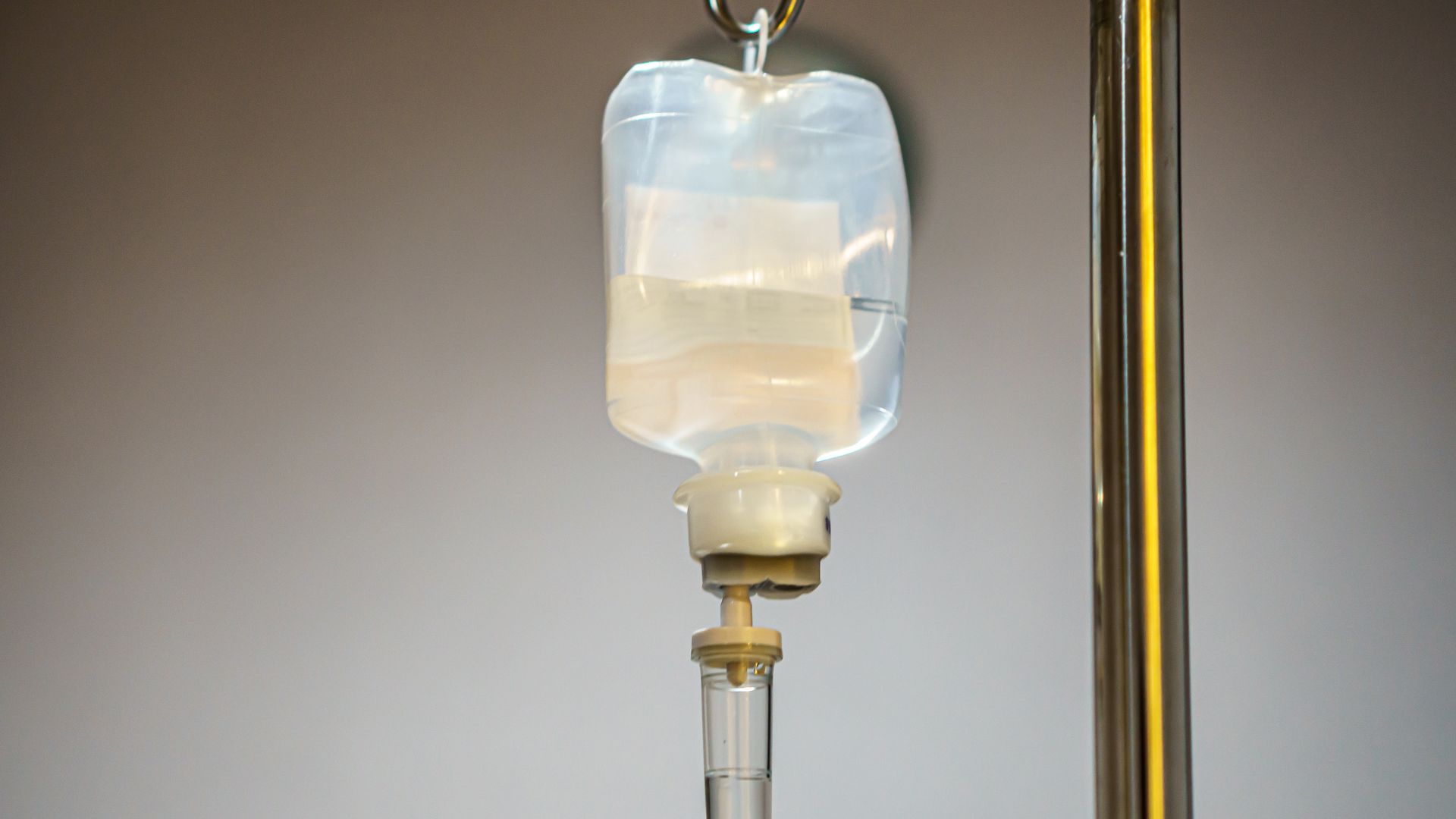
NAD+ (nicotinamide adenine dinucleotide) is a molecule every cell uses to turn food into energy and to run enzymes that repair DNA. Levels fall with age, and in mice, restoring them improves several markers of aging. That story has built a market of supplements such as NMN and NR, plus clinics offering NAD+ drips and injections. The question is whether raising NAD+ in people does anything you would notice.
The Claim
“NAD+ declines as you age. Boosting it with NMN, NR, or an NAD+ IV restores your energy and slows aging at the cellular level.”
(Composite representative claim drawn from supplement brand and IV clinic marketing.)
Where the Idea Comes From
In a study of about 30 adults aged 20 to 87, blood NAD+ was lower in older participants. The study was small, and researchers still debate how consistent the decline is across tissues.
The mouse data are more striking. In the Imai lab, mice given NMN in their water for 12 months gained less weight with age and had better insulin sensitivity, activity, and eye function. In the Sinclair lab, a week of injected NMN restored mitochondrial markers in the muscle of old mice. These studies created the field. They used doses far higher, per kilogram of body weight, than any capsule people take, and mouse results often fail to carry over to humans.
Do NMN and NR Raise NAD+ in People?
Yes. This part is well established. Nicotinamide riboside (NR, sold as Niagen) raised blood NAD+ in a dose-dependent way in a 12-person pharmacokinetic trial, and a 6-week trial of 1,000 mg a day raised NAD+ in blood cells by about 60%. NMN trials show similar rises in blood levels. A higher number on a blood test is not the same as a health benefit, though, and that is where the evidence thins out.
What the Human Trials Show
| Trial | Who and how long | Result |
|---|---|---|
| NR, Dollerup 2018 | 40 obese men, 2,000 mg/day, 12 weeks | No change in insulin sensitivity or body composition |
| NR, Martens 2018 | 24 healthy older adults, 1,000 mg/day, 6 weeks | Blood pressure fell 3.9 mmHg, not significant after correction; exploratory outcome |
| NR, Elhassan 2019 | 12 men aged 70–80, 1 g/day, 21 days | Lower inflammatory markers; no mitochondrial benefit |
| NMN, Yoshino 2021 | 25 women with prediabetes, 250 mg/day, 10 weeks | Muscle insulin sensitivity up 25%; no change in body composition, blood pressure, or lipids |
| NMN, Yi 2023 | 80 adults aged 40–65, 300–900 mg/day, 60 days | Longer six-minute walk; industry-funded |
| NR, NOPARK 2026 | 410 people with Parkinson’s, 1,000 mg/day, 52 weeks | No benefit; symptom scores slightly worse than placebo |
Two summaries put these results in context. A 2024 meta-analysis of 8 NMN trials with 342 participants found no significant effect on blood sugar, insulin, HbA1c, or cholesterol. A 2023 review of 25 human NR and NMN studies in Science Advances, written by researchers who ran several of them, found “few clinically relevant effects” and a tendency in the field to exaggerate results.
NOPARK is the most important new result. It was the largest and longest NAD+ trial so far, in a disease where earlier small studies had looked promising. It found no benefit. The worsening on NR was below the size usually considered clinically meaningful, but the trial clearly did not support NR as a treatment.
NAD+ IV Drips and Injections
IV clinics promise faster and more complete results than capsules. The evidence for that is thin. The most cited study, Grant 2019, gave 11 men a 6-hour infusion of 750 mg NAD+. Blood NAD+ did not change for at least 2 hours and was about 400% higher by the end. The study measured blood levels only, not any health outcome, and it was funded by an NAD+ company.
Faster infusions are uncomfortable. In a 2026 review of clinic records, all 6 clients who received NAD+ infusions reported nausea, chest pressure, and cramping, and each infusion took about 97 minutes. The authors all worked for the clinic. Quality is also a concern: in October 2025, a GenoGenix NAD+ injection was placed under a Class I recall for elevated endotoxin, the FDA’s most serious recall category. We could not find any controlled trial showing that NAD+ drips improve energy, recovery, or aging.
Is NMN Even Legal as a Supplement?
For a while, the FDA said no. In 2022 it took the position that NMN was excluded from the supplement definition because it was being studied as a drug. The Natural Products Association sued in 2024, and in late September 2025 the FDA reversed course, concluding NMN had been marketed as a supplement first. NMN is legal to sell as a supplement again. As with any supplement, legal status says nothing about whether it works.
What’s Actually in the Bottle
A 2024 study in GeroScience tested 18 NMN products bought online. Three contained no detectable NMN, and the rest ranged from 28.6% above the labeled amount to well below it. If you buy NMN, choose a product with third-party testing.
There are also open safety questions about long-term use. In mice, higher NAD+ increased the inflammatory signals released by senescent cells. This has not been shown in people, but no human trial has run long enough to rule it out.
The Cheap Alternatives
Older forms of vitamin B3 also feed NAD+ production. Niacin is cheap, but it causes flushing, and in the 25,673-patient HPS2-THRIVE trial it gave no cardiovascular benefit and increased new diabetes cases (9.1% vs 7.3%). Nicotinamide does not cause flushing and has one solid result: in the ONTRAC trial, 500 mg twice daily reduced new non-melanoma skin cancers by 23% in high-risk patients. That is a specific medical use, not a general anti-aging effect. Nicotinamide is the same molecule as niacinamide, which we cover in our niacinamide concentration guide.
What This Means for You
NMN and NR do what the label says at the most basic level: they raise NAD+ in your blood. After a decade of human trials, there is no consistent evidence that this improves energy, metabolism, or aging, and the largest trial to date found no benefit. NAD+ drips cost more, take longer, often cause nausea and chest pressure, and have no outcome data. If you want to try NMN or NR anyway, choose a third-party-tested product and treat it as an experiment rather than a proven treatment. For the broader longevity category, see our anti-aging peptides review.
Verdict: Claim Overstated
NMN and NR reliably raise blood NAD+, and the mouse data are real. Human trials are small, short, often industry-funded, and mostly null on outcomes people care about. The largest trial, in Parkinson’s disease, found no benefit. NAD+ IV drips have pharmacokinetic data only, frequent side effects, and no evidence of benefit.
References & Further Reading
- Age-related change in plasma NAD+ in adults. PubMed Central.
- Mills, K. F., et al. (2016). Long-term administration of NMN mitigates age-associated physiological decline in mice. Cell Metabolism.
- Gomes, A. P., et al. (2013). Declining NAD+ induces a pseudohypoxic state disrupting nuclear-mitochondrial communication during aging. Cell.
- Trammell, S. A. J., et al. (2016). Nicotinamide riboside is uniquely and orally bioavailable in mice and humans. Nature Communications.
- Martens, C. R., et al. (2018). Chronic nicotinamide riboside supplementation is well-tolerated and elevates NAD+ in healthy middle-aged and older adults. Nature Communications.
- Dollerup, O. L., et al. (2018). A randomized placebo-controlled clinical trial of nicotinamide riboside in obese men. American Journal of Clinical Nutrition.
- Elhassan, Y. S., et al. (2019). Nicotinamide riboside augments the aged human skeletal muscle NAD+ metabolome. Cell Reports.
- Yoshino, M., et al. (2021). Nicotinamide mononucleotide increases muscle insulin sensitivity in prediabetic women. Science.
- Yi, L., et al. (2023). The efficacy and safety of β-nicotinamide mononucleotide supplementation in healthy middle-aged adults. GeroScience.
- Meta-analysis of NMN trials on glucose and lipid metabolism (2024). Current Diabetes Reports.
- Review of human NAD+ precursor trials (2023). Science Advances.
- NOPARK trial of nicotinamide riboside in Parkinson’s disease (2026). JAMA. See also the University of Bergen summary.
- Grant, R., et al. (2019). A pilot study investigating changes in the human plasma and urine NAD+ metabolome during a 6 hour intravenous infusion of NAD+. Frontiers in Aging Neuroscience.
- Reyna et al. (2026). Retrospective review of NAD+ and NR infusions. PubMed Central.
- Class I recall of GenoGenix NAD+ injection (2025). HMP Global Learning Network.
- Nutritional Outlook. NPA lawsuit against FDA on NMN stayed (2024) and FDA amends its position on NMN (2025).
- Independent testing of NMN supplement products (2024). GeroScience.
- NAD+ and the senescence-associated secretory phenotype in mice. PubMed Central.
- American College of Cardiology. (2013). HPS2-THRIVE results.
- Chen, A. C., et al. (2015). A phase 3 randomized trial of nicotinamide for skin-cancer chemoprevention (ONTRAC). New England Journal of Medicine.
- Marketing or Science. Niacinamide concentration guide and Anti-aging peptides and longevity.