The same ponytail wound the same three times, is suddenly loose on the third pass. You start noticing more hair in your brush or in the shower drain. You look back at a photo taken under an overhead light, and the part looks wider than you remember.
Most women get some version of it’s just age, which explains nothing and makes it seem like there’s nothing to be done about it. Here’s the science behind why it’s happening now, and what real solutions are available.
The Science Behind Menopausal Hair Loss
Menopause is most notably marked by a drop in estrogen and progesterone levels. When this happens a few things can be true about your hair:
- Shorter growth phase: Estrogen helps keep your hair in its growth phase for longer. With less of it, that phase shortens and more hairs sit in the resting phase at once — slower hair growth and more shedding (Owecka et al., 2024).
- Androgen sensitivity: In your scalp an enzyme called 5-alpha reductase changes testosterone into a more potent androgen, dihydrotestosterone (DHT). DHT is known to bind to receptors in the hair follicle and cause these follicles to shrink — hair grows back thinner, and parts become wider (Grymowicz et al., 2020).
- Less scalp circulation: The cells located in your hair follicles receive nutrients from their surrounding scalp environment. Lower estrogen levels can reduce blood circulation in your scalp; this in turn means decreased delivery of oxygen and necessary nutrients to the hair follicles resulting in weaker follicles (Rinaldi et al., 2023).
Solutions for Menopausal Hair Loss
Search this and you’ll find the same list every time: minoxidil, hormone replacement therapy (HRT), oral supplements like Nutrafol, prescription options like spironolactone, and further down the thread — rosemary oil, dermarolling, red light caps, PRP injections.
But one category has grown faster than all of them, and it’s the one with the widest gap between what’s claimed and what’s been tested: topical hair serums. They’re the easiest thing to start, the easiest thing to market, and the hardest to compare — because almost every brand reports a different kind of number and calls it clinical.
RE:YOU, Vegamour, Hers, and OneSkin are brands that promise hair support through the menopause transition. Their evidence ranges from a 40-person opinion survey to a 190-woman double-blind trial run against an actual drug. We looked past the flashy numbers and product pages and did a deep dive into each study to see who can back their product up with real science.
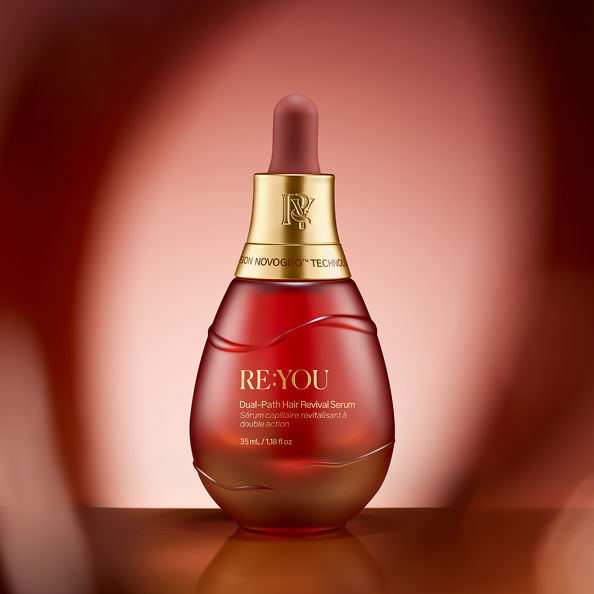
Evidence & Clinical Results
| What we checked | RE:YOU Dual-Path Revival Serum |
|---|---|
| Participants | 190 women, visible hair thinning |
| Design | double-blind, randomized |
| Compared against | OTC minoxidil |
| Measured by | trichoscopy + expert grading, self-reported questionnaire |
Interim 3-month clinical results, from a double-blind, randomized, minoxidil-benchmarked trial with 190 female participants. See the full data →
Hero Ingredients
Mechanism & How It Works
RE:YOU’s formula is centered around their unique NOVOGRO™ technology — molecules developed specifically for addressing hair thinning and hair loss seen in older women, and built by their in-house team of PhD scientists.
NOVOGRO™-623 and NOVOGRO™-624 act on the dermal papilla — the small cluster of cells at the base of each follicle that decides whether it grows, rests or sheds. These cells are influenced by estrogen signaling, which changes as estrogen levels decline. The molecules increase their energy production and activity, which is what extends the growth phase back out.
NOVOGRO™-273 works on the scalp itself, improving how much oxygen and nutrients reach the follicle; this is the mechanism many products overlook (Qu et al., 2026).
RE:YOU doesn’t try to fight the hormones — it goes to the root of hair growth, rebuilding the follicle’s own machinery and its supply line, and this is why it works without touching your hormones at all.
Evidence & Clinical Results
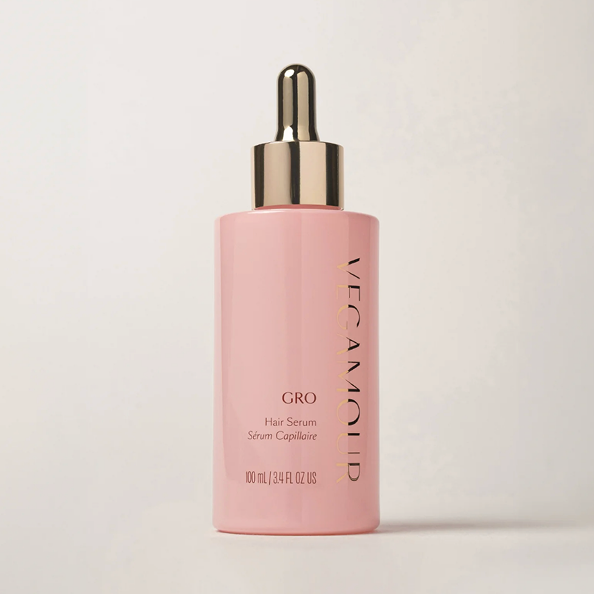
| What we checked | Vegamour GRO Hair Serum |
|---|---|
| Participants | 40 |
| Design | consumer perception survey, 120 days |
| Compared against | nothing |
| Measured by | self-reported questionnaire |
Hero Ingredients
Mechanism & How It Works
Caffeine has shown some ability to stimulate follicles in lab conditions, and the botanical extracts are there to condition the scalp and support the hair already growing. Peptides and exosomes are two new trends in the wellness space with promising science, but researchers are waiting for more evidence on their efficacy in topical formulas. Overall, Vegamour’s GRO Hair Serum is a maintenance formula: it works on the environment around the follicle rather than on any of the three mechanisms driving menopausal loss. Nothing in it addresses DHT, and nothing is aimed at extending the growth phase.
Evidence & Clinical Results
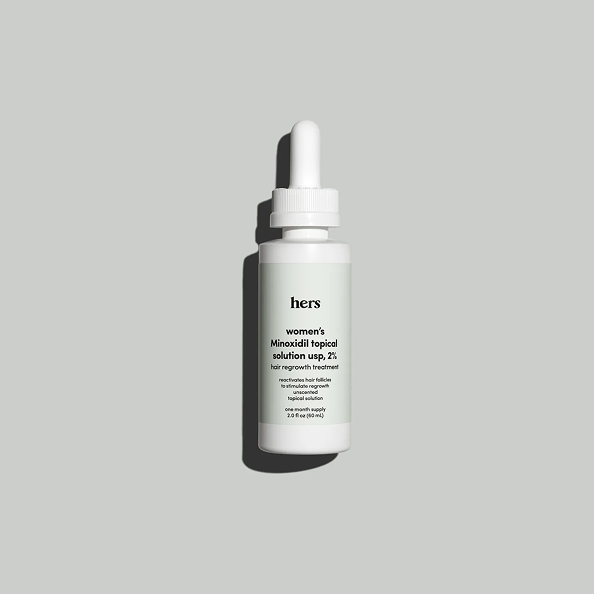
| What we checked | Hers Minoxidil 2% |
|---|---|
| Active ingredient | 40+ years of independent research around minoxidil; FDA-approved |
| Product testing | no clinical trial or customer survey for this product |
| Measured by | previously published data around minoxidil |
Hero Ingredients
Mechanism & How It Works
Minoxidil was first developed as a drug for high blood pressure. Hair growth was discovered to be a side effect of the drug, and gave way to minoxidil’s development as a hair thinning treatment. It works by expanding blood vessels in the scalp which in turn improves nutrient delivery to the hair follicle (Suchonwanit et al., 2019).
It is the longest-studied hair treatment that exists and the only one here approved by the FDA for women’s hair loss. That being said, it does nothing about DHT — the shrinking-follicle mechanism goes untouched — and requires consistent perpetual use. Additionally, users typically experience one of the many side effects of minoxidil including the initial “dread shed”, scalp irritation, and unwanted body and facial hair growth.
Evidence & Clinical Results
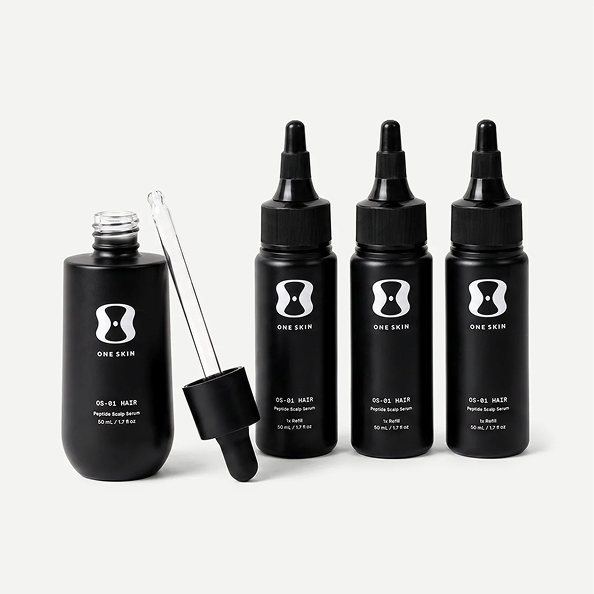
| What we checked | OneSkin OS-01 HAIR |
|---|---|
| Participants | 32, men and women aged 22–55 |
| Design | randomized — no control group |
| Compared against | nothing |
| Measured by | HairMetrix photography, trichoscopy, phototrichogram |
| Confounding factor | all participants dermarolled daily in addition to using the serum |
Hero Ingredients
Mechanism & How It Works
OS-01 peptide and fisetin are both aimed at senescence — the stage where follicle cells have aged into dormancy (OneSkin). It’s a genuinely interesting bet, and the science behind cellular aging is real, but it’s a bet on a different problem. Menopausal thinning is driven by a hormonal shift, not just age. If aging cells are part of your picture, it’s relevant. If the cause is the drop in estrogen, it becomes less relevant.
The Bottom Line
Four serums, four promises, four completely different kinds of proof. Vegamour’s 93% came from 40 people answering a questionnaire — nobody counted a single hair. OneSkin’s 40% came from about 30 people who were also using a dermaroller daily, with no comparison group to separate the effects of the hair serum from the dermaroller. Hers uses an ingredient backed with forty years of research and an FDA approval behind it, but asks for a few weeks of increased shedding to start, and other side effects you can’t predict.
RE:YOU did the one thing none of the others did. It ran the most rigorous clinical trial in the category with 190 women, double-blinded, against the gold standard of hair thinning treatment, and outperformed it.
If what you want is the strongest evidence available without taking a drug or interfering with your hormones, right now there’s one clear answer. RE:YOU is the only serum here built specifically for what menopause does to hair, and the only one that set itself up for a test many others would have failed.
Menopause changes a lot about your body. Your hair doesn’t have to be part of it.
References & Further Reading
- Owecka, B., Tomaszewska, A., Dobrzeniecki, K., & Owecki, M. (2024). The hormonal background of hair loss in non-scarring alopecias. Biomedicines, 12(3), 513.
- Grymowicz, M., Rudnicka, E., Podfigurna, A., et al. (2020). Hormonal effects on hair follicles. International Journal of Molecular Sciences, 21(15), 5342.
- Rinaldi, F., Trink, A., Mondadori, G., et al. (2023). The menopausal transition: Is the hair follicle “going through menopause”?. Biomedicines, 11(11), 3041.
- Qu, Z., Li, Y., Cho, S. E., et al. (2026). AI-enabled discovery of small molecules targeting complementary pathways for hair follicle rejuvenation. bioRxiv.
- Suchonwanit, P., Thammarucha, S., & Leerunyakul, K. (2019). Minoxidil and its use in hair disorders: A review. Drug Design, Development and Therapy, 13, 2777–2786.
- OneSkin. Rooted in science: The clinical evidence supporting OS-01 HAIR.