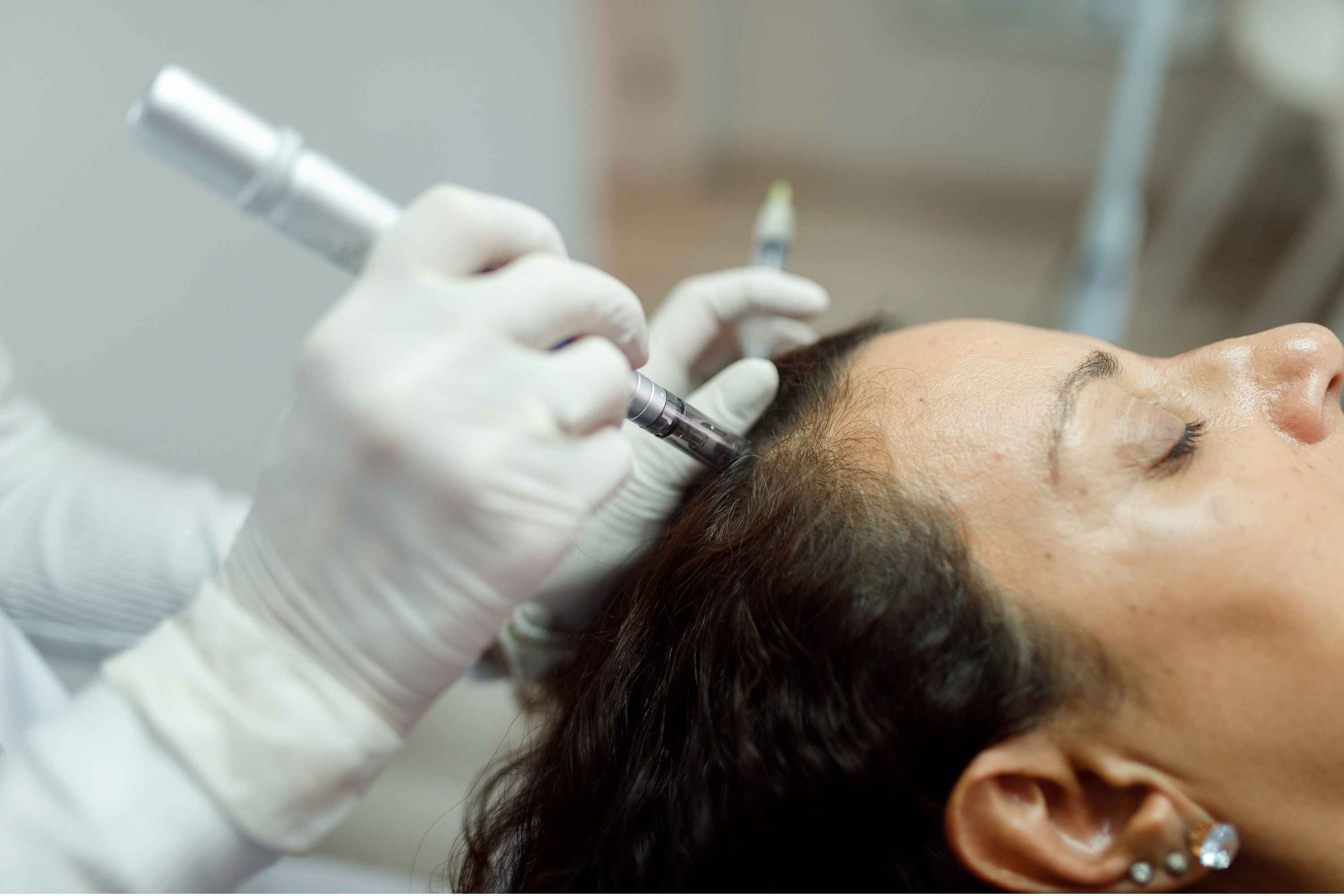
Microneedling — also sold as dermarolling or scalp needling — has become one of the most popular at-home hair-loss interventions of the last few years. The pitch is appealing: no drugs, no prescription, just a roller studded with fine needles that you run across the scalp to “stimulate” dormant follicles into regrowing thicker hair. Clinics offer professional versions; Amazon sells dermarollers for the price of a sandwich.
The mechanism is genuinely plausible, and unlike many trendy actives the needling has real randomized-trial data behind it. The catch is subtle but decisive: nearly every one of those trials tested microneedling plus minoxidil against minoxidil alone. That design tells you needling adds something, but it cannot tell you how much the needle does on its own — the same isolation problem seen in the reviews of copper peptides and saw palmetto.
The Wound-Healing Mechanism
The mechanistic case is the strongest part of the story. Controlled micro-injury to the scalp triggers the body's wound-healing cascade: release of platelet-derived and other growth factors, and activation of Wnt/β-catenin signaling — a pathway central to the hair-follicle growth cycle. In principle, this nudges follicles from their resting (telogen) phase into the active growth (anagen) phase.
There is a second, more practical mechanism: the microchannels the needles create can transiently increase how much topical minoxidil penetrates the scalp. That is a real effect — but notice it makes needling a delivery enhancer for a drug that already works, not necessarily a standalone treatment. Both mechanisms are reasonable. The question, as always, is whether they translate into measurably more hair in controlled human trials.
The Claim
“Microneedling activates your body's natural healing response to wake up dormant follicles and regrow thicker hair — a clinically proven, drug-free treatment you can do at home.”
(Composite representative claim; reflects language used across dermaroller and at-home scalp-microneedling products.)
The Human Evidence Problem
The single most-cited human study is Dhurat et al. (2013), “A Randomized Evaluator Blinded Study of Effect of Microneedling in Androgenetic Alopecia: A Pilot Study” in the International Journal of Trichology. It is the study every product page points to, and its headline number is striking: at 12 weeks, the microneedling group's mean change in hair count was far larger than the minoxidil-only group's, and 82% of needling patients reported over 50% improvement versus 4.5% in the comparison arm.
But look at the arms. Both groups used minoxidil 5% twice daily; the treatment group added weekly microneedling on top. So the trial compares “minoxidil + needling” against “minoxidil alone.” It shows needling adds benefit as an adjunct — a legitimate and useful finding — but by design it cannot isolate whether microneedling alone regrows hair. It was also a pilot study of 100 men, evaluator-blinded but not sham-controlled, and patients knew whether they were being needled, which invites a placebo effect in the self-reported scores.
Later randomized trials, such as the single-observer-blinded study of topical minoxidil plus microneedling versus minoxidil alone, repeat the same structure and generally point the same direction: needling helps when added to minoxidil. A 2025 systematic review and meta-analysis of combined microneedling therapy reached a similar conclusion — favorable as an add-on, with studies that are small, heterogeneous in needle depth and frequency, and at meaningful risk of bias. What is still missing is a large, sham-controlled trial of microneedling by itself.
How This Compares to the Gold-Standard Actives
The “clinically proven” language only means something against the actual bar, and for hair loss that bar is minoxidil and finasteride — both backed by large, replicated, randomized controlled trials and regulatory review. Microneedling's evidence is best read as complementary to minoxidil, not a replacement for it.
| Approach | Best Human Evidence for Hair | Can It Be Isolated? | Regulatory Status |
|---|---|---|---|
| Minoxidil | Multiple large RCTs; decades of use | Yes — studied as monotherapy | FDA-approved for hair loss |
| Finasteride | Large RCTs in male pattern hair loss | Yes — studied as monotherapy | FDA-approved (men) |
| Microneedling | Several small RCTs — almost all as an add-on to minoxidil (Dhurat 2013 pilot; later combination trials) | No — rarely tested alone vs a sham | Device/procedure; not approved as a hair-loss treatment |
What the Evidence Actually Shows
Microneedling has a plausible wound-healing mechanism and, unusually for a trendy hair intervention, real randomized-trial support — but that support is almost entirely as an adjunct to minoxidil. The most-cited trial (Dhurat 2013) added weekly needling on top of twice-daily minoxidil in both-arms-on-minoxidil designs, so it demonstrates added benefit rather than standalone efficacy. Studies are small, vary widely in needle depth and frequency, and lack sham controls. There is no large trial establishing that microneedling alone regrows hair, and none showing it rivals or replaces minoxidil or finasteride.
Verdict & Practical Implications
Verdict: Claim Overstated
The “clinically proven, drug-free” framing is overstated. The evidence genuinely supports microneedling as an add-on that improves results on top of minoxidil — a real, if modest, finding — but it does not support the claim that needling alone regrows hair, and the trials cannot separate the needle's effect from the drug's. Evidence rating: 3/5 — plausible mechanism and real adjunct data, undercut by combination designs, small samples, and no sham-controlled monotherapy trial.
For anyone treating hair loss, the practical takeaway is that microneedling is a reasonable complement to an evidence-backed active, not a substitute for one. If you are already using topical minoxidil, adding periodic microneedling is a low-cost intervention with plausible upside, provided it is done carefully. The real risks are practical: needling too deep or too often can irritate or scar the scalp, and shared or poorly cleaned rollers are an infection route — use a clean device, conservative depth, and no more than about weekly. And as always, ruling out underlying contributors such as iron deficiency matters more than any single gadget. Treat the dermaroller as a helper for a treatment that works, not as the treatment itself.
References & Further Reading
- Dhurat, R., et al. (2013). A Randomized Evaluator Blinded Study of Effect of Microneedling in Androgenetic Alopecia: A Pilot Study. International Journal of Trichology, 5(1), 6–11.
- Jha, A. K., et al. (2018). A Randomized Controlled, Single-Observer Blinded Study to Determine the Efficacy of Topical Minoxidil plus Microneedling versus Topical Minoxidil Alone in the Treatment of Androgenetic Alopecia. Journal of Cutaneous and Aesthetic Surgery.
- (2025). Evaluating the Efficacy and Safety of Combined Microneedling Therapy versus Topical Minoxidil in Androgenetic Alopecia: A Systematic Review and Meta-Analysis.
- Marketing or Science. Minoxidil for Female Pattern Hair Loss (gold-standard comparator evidence).
- Marketing or Science. Copper Peptides (GHK-Cu) for Hair Growth (the same combination/isolation problem in another active).