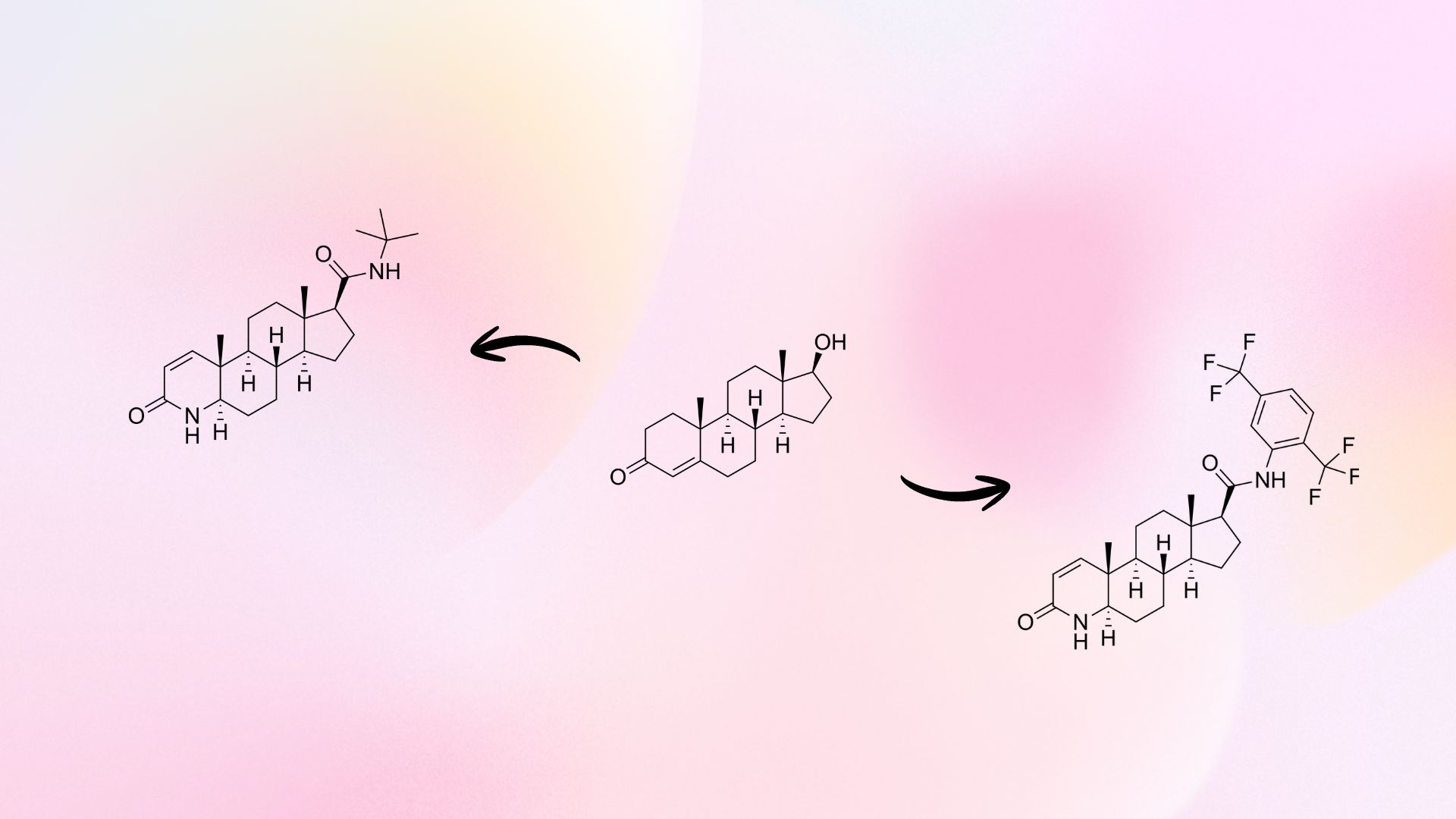
Once someone learns that finasteride works for hair loss by blocking 5-alpha-reductase and reducing DHT, the next question almost writes itself: if dutasteride blocks the same enzyme more completely — both type I and type II isoforms, rather than mainly type II — isn’t it simply the better drug?
The head-to-head evidence says: modestly, yes. But “stronger” and “better for you” are different questions, and the regulatory landscape, half-life, and side-effect considerations add real complexity to a superficially simple comparison.
Part of a Series
This article is part of our Hair Loss: Marketing or Science? series, examining the evidence behind popular treatments and ingredients.
- Hair Growth Supplements (Nutrafol, Viviscal, Biotin)
- Caffeine Shampoo (Alpecin): Does It Actually Work?
- Spironolactone for Female Hair Loss
- You are here: Dutasteride vs. Finasteride: Is “Stronger” Actually Better?
- Prostaglandin Analogs (Latanoprost, Bimatoprost) for Scalp Hair Loss
- Exosomes, Stem Cells & Hair Cloning: The Frontier Hype
The Mechanism: Why Dutasteride Suppresses More DHT
Both drugs inhibit 5-alpha-reductase (5AR), the enzyme that converts testosterone into dihydrotestosterone (DHT) — the androgen primarily responsible for follicle miniaturization in androgenetic alopecia. The difference is isoenzyme coverage:
- Finasteride selectively inhibits the type II isoenzyme, which is the dominant 5AR form in the scalp and prostate. It reduces serum DHT by approximately 70–75%.
- Dutasteride inhibits both type I and type II isoenzymes. Type I is expressed in the liver, skin, and sebaceous glands. Dual inhibition reduces serum DHT by approximately 90–95%.
Because both isoenzymes are present in the hair follicle, the theoretical case for greater efficacy with dual inhibition is sound. The question is whether that additional DHT suppression translates into meaningfully better clinical outcomes — and whether the trade-offs are worth it.
The Claim
“Dutasteride is simply the stronger version of finasteride — it suppresses DHT more completely and regrows more hair. For anyone serious about treating hair loss, it’s the obvious upgrade.”
(Composite representative claim; reflects how dutasteride is positioned on hair-loss forums, telehealth platforms, and some prescriber materials.)
What the Head-to-Head Evidence Shows
The evidence does support a modest efficacy advantage for dutasteride. The landmark study, Olsen et al. (2006), showed dutasteride 2.5 mg was superior to finasteride 5 mg at 12 and 24 weeks for increasing target-area hair count in men with androgenetic alopecia. A 2019 systematic review and meta-analysis of three head-to-head trials (576 participants) found dutasteride provided significantly better total hair count (mean difference 28.57 hairs), photographic global assessment, and subjects’ self-assessment compared with finasteride over a 24-week cycle. A 2024 comparison study confirmed that dutasteride 0.5 mg and 2.5 mg both outperformed finasteride on hair count and reversal of miniaturization in both male and female androgenetic alopecia.
The advantage is real but not dramatic. In the meta-analysis the mean difference was roughly 28 hairs over 24 weeks — statistically significant, clinically meaningful to some patients, but not a categorical leap. Both drugs work; dutasteride works a bit better on average.
The Regulatory and Practical Gap
Here is where “stronger” runs into a wall. In the United States, dutasteride is not FDA-approved for hair loss. It is approved for benign prostatic hyperplasia (BPH) under the brand name Avodart. Hair-loss use in the US is off-label, meaning a prescriber can write the prescription but the drug has not gone through the FDA’s specific review process for androgenetic alopecia. By contrast, finasteride 1 mg (Propecia) has FDA approval for male pattern hair loss, with a defined indication and manufacturer-supported evidence package. Dutasteride does hold hair-loss approvals in South Korea and Japan, where it is used at 0.5 mg.
The other practical consideration is pharmacokinetics. Dutasteride has an extremely long half-life of approximately 5 weeks, compared to finasteride’s 6–8 hours. This has two implications: it takes longer to reach steady state, and if side effects occur, the drug takes weeks to clear the system. Finasteride, with its short half-life, clears much faster if discontinued. For a patient who experiences sexual side effects or other adverse events, this distinction matters.
| Finasteride | Dutasteride | |
|---|---|---|
| 5AR isoenzymes inhibited | Type II (mainly) | Type I & II |
| DHT suppression | ~70–75% | ~90–95% |
| Hair-loss efficacy vs. each other | — | Modestly superior (meta-analysis) |
| FDA approval for hair loss | Yes (men, 1 mg) | No (off-label in US) |
| Half-life | 6–8 hours | ~5 weeks |
| Clears quickly if stopped | Yes | No — weeks to clear |
What the Evidence Actually Shows
Dutasteride does outperform finasteride in head-to-head trials — the meta-analysis data are consistent and the difference is statistically significant. But the advantage is modest in absolute terms, the drug is not FDA-approved for hair loss in the US, and its five-week half-life means side effects linger long after stopping. “Stronger” is accurate; “obviously better for everyone” is not.
Verdict & Practical Implications
Verdict: Partially Supported
The superiority claim is partially supported. Dutasteride is modestly more effective than finasteride for androgenetic alopecia based on head-to-head trial data. Evidence rating: 3/5 — real efficacy advantage, meaningfully complicated by regulatory status, long half-life, and the absence of a head-to-head trial against the approved 1 mg finasteride dose in a large independent study.
For men who have tried finasteride and had an inadequate response, dutasteride is a clinically reasonable next step in discussion with a prescriber — particularly given the evidence that additional DHT suppression does produce additional benefit. For someone starting treatment, the FDA-approved, shorter-half-life finasteride is the lower-risk entry point, with dutasteride available as an escalation. This is a prescriber conversation, not a self-upgrade. And in women, both drugs are teratogens with significant contraindications — see our review of finasteride in female hair loss for the evidence on that population.
References & Further Reading
- Olsen, E. A., et al. (2006). The importance of dual 5alpha-reductase inhibition in the treatment of male pattern hair loss: results of a randomized placebo-controlled study of dutasteride versus finasteride. Journal of the American Academy of Dermatology, 55(6), 1014–1023.
- Gubelin Harcha, W., et al. (2014). Superiority of dutasteride over finasteride in hair regrowth and reversal of miniaturization in men with androgenetic alopecia. Journal of the American Academy of Dermatology.
- Zhou, Z., et al. (2019). The efficacy and safety of dutasteride compared with finasteride in treating men with androgenetic alopecia: a systematic review and meta-analysis. Clinical Interventions in Aging, 14, 399–406.
- Bagatin, E., et al. (2024). Comparison between dutasteride and finasteride in hair regrowth and reversal of miniaturization in male and female androgenetic alopecia. PubMed.
- Marketing or Science. DHT Blockers: Finasteride, Saw Palmetto, and the Evidence Gap.
- Marketing or Science. Finasteride for Female Hair Loss.