Evidence-Based Review · Dr. Brian Huber, MD

The Minoxidil Dilemma: Is There a Serious Minoxidil-Free Option?

If you're researching thinning hair, you've almost certainly hit the same wall: the one topical everyone recommends — minoxidil — is a repurposed blood-pressure drug that can bring its own trade-offs. Increased shedding for the first several weeks. Unwanted facial hair. Scalp dryness, itching, flaking, or redness. And results that only last as long as you keep using it. Taking thinning seriously shouldn't mean accepting a drug that doesn't fit your preferences — but the usual alternative is a cosmetic serum that does nothing mechanistically. This review looks at that false choice and at whether a serious, minoxidil-free and non-hormonal option, built specifically around hair biology and benchmarked against minoxidil, has finally arrived.

Evidence Based Clinical Review

The Dilemma Nobody Names Out Loud

Most people who reach the point of actively researching thinning hair are not looking for a miracle. They want to take the problem seriously and do something that actually works — but they've also read enough to feel uneasy about the default recommendation. Minoxidil is effective for many users, and it is still the first-line topical standard. The hesitation isn't about whether it does something; it's about what comes attached to it.

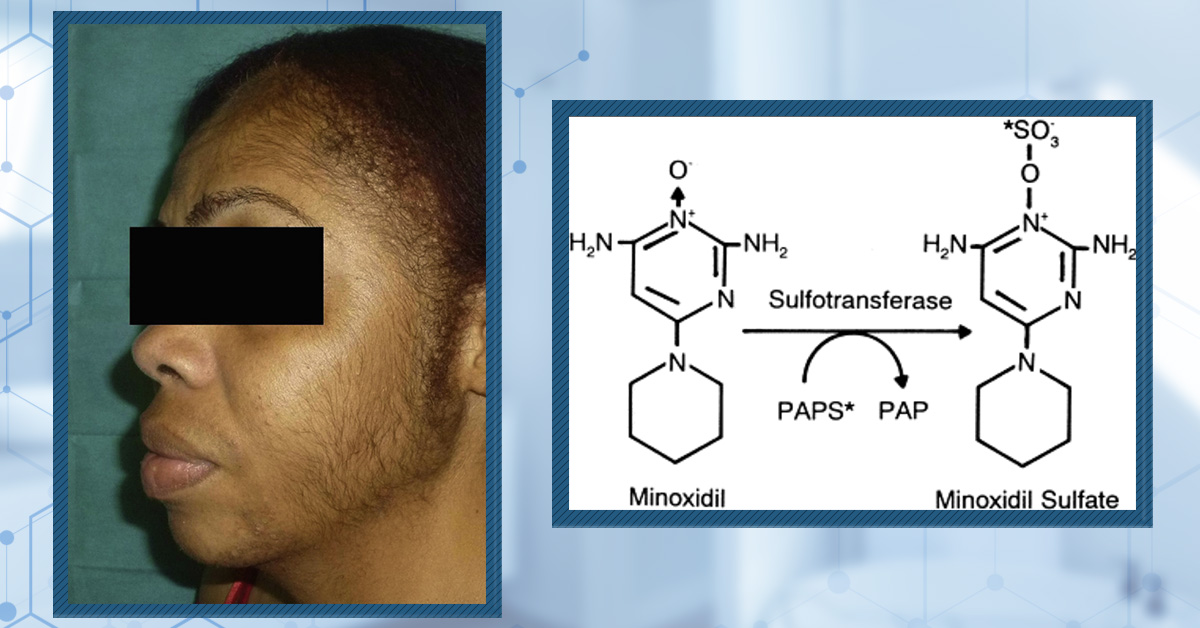
The honest version of the trade-off looks like this: an initial shedding phase that can last several weeks and feels like the opposite of progress; the possibility of unwanted facial hair (hypertrichosis), particularly with the oral form; scalp side effects such as dryness, itching, flaking, or redness; and the reality that whatever you gain reverses once you stop, because maintaining results requires continued use indefinitely. None of that makes minoxidil a bad drug. It makes it a drug that many thoughtful people would rather not build their routine around — if there were a serious alternative.

The problem is that, until recently, there wasn't one. The choice on offer was binary: a repurposed pharmaceutical, or a cosmetic serum with a pleasant scent and no mechanism. This review is about why that choice is a false one.

What Minoxidil Actually Is

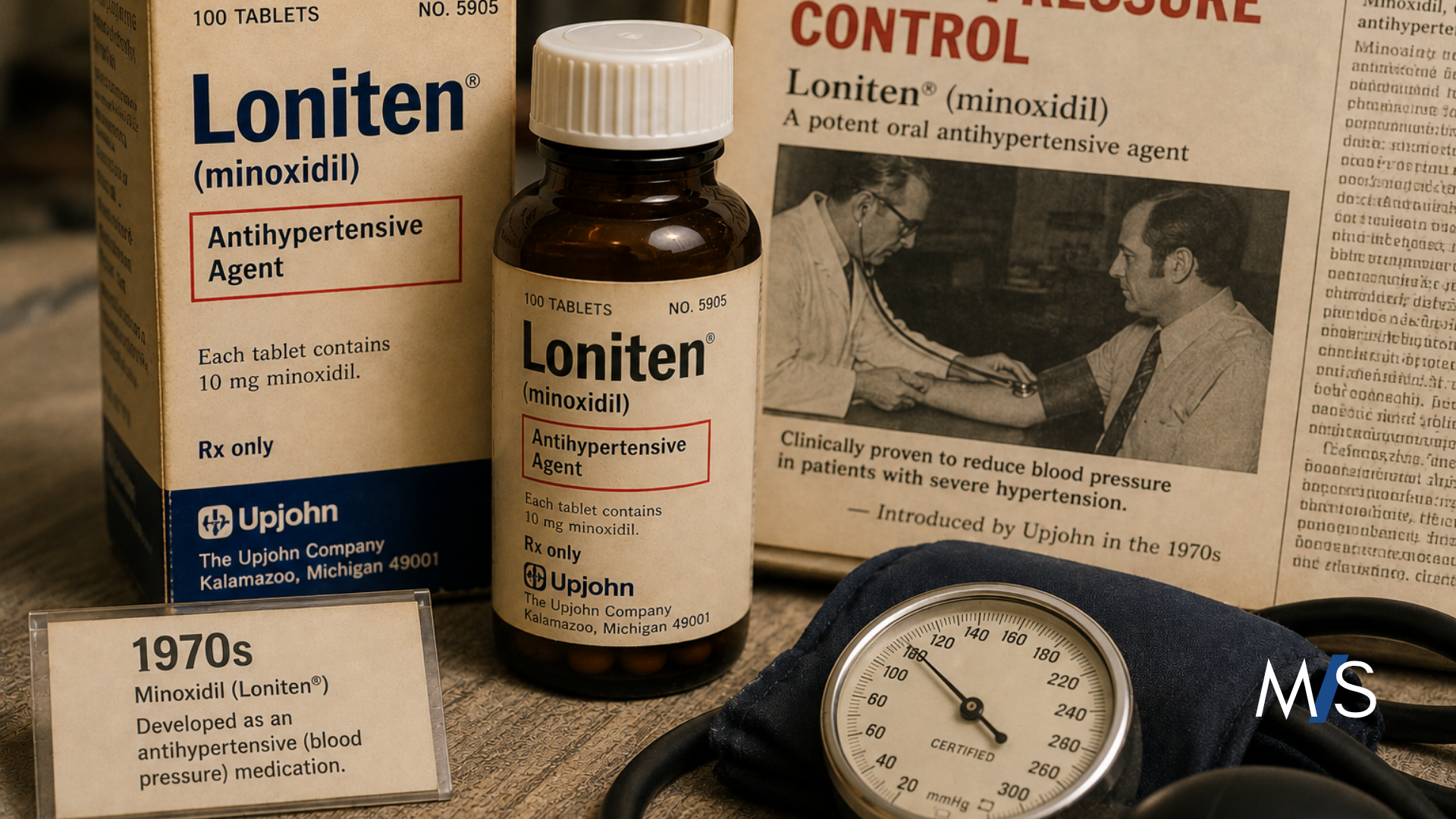
Minoxidil was never designed for hair. It entered medicine in the 1970s as a treatment for high blood pressure, and hair growth showed up as an unintended side effect: some patients on the drug started growing more hair, including in places they didn't want it. That accidental observation was repackaged into what became one of the most heavily marketed products in the entire hair-loss category.

Mechanistically, minoxidil is best understood as a vasodilator and potassium-channel opener. It increases blood flow around the follicle and helps some hairs stay in the anagen (growth) phase longer, partly by upregulating VEGF in dermal papilla cells (Lachgar et al., 1998) via inhibition of HIF-prolyl hydroxylase (Yum et al., 2017). Notably, even its growth-supportive effect appears to be largely indirect — routed through growth-factor release from adipose-derived stem cells (Choi et al., 2018) rather than acting on the follicle itself. In plain terms: minoxidil mostly works on the environment around the follicle, not the follicle's own growth machinery.

That mechanism is exactly why the trade-offs show up. Because it shifts follicles out of rest and into growth all at once, many users see an initial shedding phase in the first weeks as cycles reset. Because it's a vasodilator that doesn't stay perfectly local, it can drive unwanted hair growth beyond the scalp. Because it's applied to skin, it commonly causes irritation — dryness, itching, flaking, redness. And because it doesn't address the underlying drivers of miniaturization, the benefit is tied to continued use: stop, and the gains fade. These aren't fringe complaints; they're the predictable downstream of a repurposed drug working through a single, indirect pathway.

The False Choice: Cosmetic Serum vs. Repurposed Drug

Once someone decides minoxidil isn't for them, the market hands them a disappointing menu. On one side sit the cosmetic and botanical serums — pleasant, well-packaged, and largely mechanism-free. They may temporarily improve the appearance of fullness, but there's little independent, peer-reviewed evidence that they meaningfully address the biology of thinning. On the other side sits minoxidil (and, for some, the systemic hormonal route of finasteride), which does have real evidence but comes with the trade-offs above.

This is the trap: the reader is implicitly told that "serious" means "accept the drug and its side effects," and that anything minoxidil-free is by definition unserious. For decades that was roughly true, because nothing minoxidil-free was actually engineered around hair-follicle biology. Almost everything marketed as "new" was a cosmeticized repackaging of old pathways — a different serum, a gummy, a botanical blend — rather than a genuinely new mechanism.

A reader who wants to take thinning seriously deserves a third option: something built from the ground up around follicle biology, non-hormonal by design, and tested against a meaningful benchmark rather than against a placebo scent. That is the specific gap the option below is aiming at.

A Third Option: RE:YOU / NOVOGRO™

Editor's Pick · Minoxidil-Free Engineered topical

RE:YOU (NOVOGRO™ complex)

Promising — Clinical Pending
RE:YOU (NOVOGRO™ complex) Check Price →

Direct-to-consumer subscription

Non-hormonal design NV-1065 · NV-273 · NV-623/624 Multi-pathway Benchmarked vs. minoxidil Partially Supported

Pros

  • Minoxidil-free and non-hormonal — built for people who ruled those out
  • Engineered around follicle biology rather than repurposed from another drug
  • Multi-pathway: DHT (NV-1065), dermal papilla growth (NV-623/624), scalp environment (NV-273)
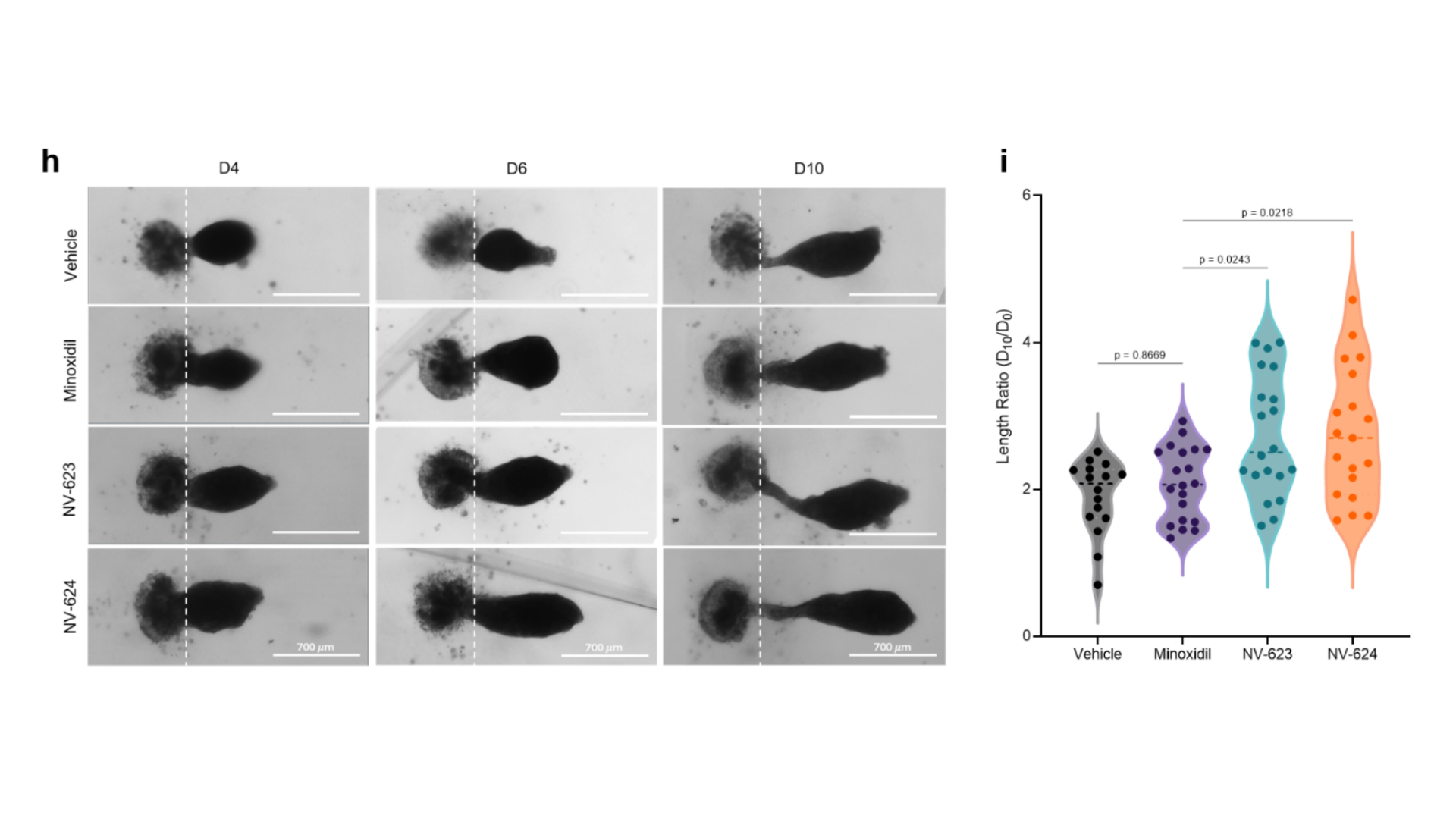
  • Outperformed minoxidil by >30% on follicle-organoid sprouting in preclinical models
  • Clean preclinical safety battery; water-soluble for simple aqueous serums

Cons

  • Full randomized clinical readout still pending — interim 3-month data so far
  • Newer brand; long-term real-world data limited
  • Direct-to-consumer subscription cost
  • Like any topical, benefits depend on consistent use

Why It's Different from Everything Else Minoxidil-Free

The reason most minoxidil-free products are unserious is that they were never designed for the follicle. RE:YOU is the exception. The NOVOGRO™ complex is a set of molecules discovered via machine-learning screening and built specifically around hair-follicle biology, described in a bioRxiv preprint: NV-1065, a non-steroidal 5-AR inhibitor that lowers DHT pressure without the systemic hormonal profile of finasteride; NV-623 and NV-624, aimed at the dermal papilla cells that orchestrate the growth cycle; and NV-273, designed to prime the scalp environment for growth. Crucially, none of that involves minoxidil and none of it is hormonal.

It also cleared a real benchmark rather than a cosmetic one. In head-to-head preclinical work, NV-623 and NV-624 drove greater dermal papilla cell proliferation than minoxidil and produced roughly 30% greater and faster sprouting in a 3D hair-follicle organoid model, using cells from real human donors in the relevant age range. That is the kind of comparison a serious reader is actually asking for: not "better than nothing," but "measured directly against the standard."

We're keeping the verdict honest. Interim 3-month clinical results are now available and are encouraging, and the preclinical package is stronger than what we usually see in this category — our own editorial team independently replicated the 5-AR inhibition result. But the full randomized readout is still pending, so we rate it Promising — Clinical Pending: confident about the direction of the data, explicit that the final proof isn't in yet. For the full mechanistic breakdown, see our three-part series linked below.

The Three Options, Side by Side

Option Type Mechanism Side-effect profile Continued use required? Evidence
Cosmetic / botanical serum OTC topical No demonstrated follicle mechanism Generally low; largely cosmetic Yes (appearance only) Weak
Minoxidil Repurposed BP drug (topical / oral) Vasodilator; prolongs anagen (indirect) Initial shedding, facial hair, scalp irritation Yes — results reverse if stopped ✓ Supported
RE:YOU / NOVOGRO™ Engineered topical (minoxidil-free) Multi-pathway; non-hormonal DHT + dermal papilla + scalp environment Clean preclinical safety; non-hormonal by design Yes (as with any topical) Promising — clinical pending

Frequently Asked Questions

Is a "serious" minoxidil-free option actually realistic?

For most of the last few decades, no — minoxidil-free almost always meant cosmetic. What's changed is that RE:YOU's NOVOGRO™ molecules were engineered specifically around follicle biology and tested directly against minoxidil in preclinical models, rather than being a botanical blend marketed as an alternative. It is minoxidil-free by design, not by omission.

Will I still get the initial shedding phase?

The dreaded early shedding with minoxidil is tied to how it forces follicles out of rest all at once. RE:YOU works through different, multi-pathway mechanisms and is not minoxidil, so it is not expected to reproduce that specific reset-driven shed. As with any topical, individual responses vary and consistency matters more than any single week.

Is it hormonal, like finasteride?

No. NV-1065 is described as a non-steroidal 5-AR inhibitor — it aims to reduce DHT-related pressure on the follicle without the systemic hormonal profile associated with finasteride. Non-hormonal design is one of the core reasons the product exists.

What does the clinical data actually show so far?

Interim 3-month clinical results are available and are encouraging, on top of a preclinical package that outperformed minoxidil on dermal papilla cell proliferation and follicle-organoid sprouting. We're candid that this is interim: the full randomized clinical readout is still pending, which is why our verdict stays "Promising — Clinical Pending" rather than a definitive score. You can review the interim clinical results directly.


References & Further Reading