Evidence-Based Review · Dr. Brian Huber, MD

Maximizing a Hair Transplant: A Dermatologist's Guide to Post-Op Regimens (2026)

A hair transplant relocates follicles — it does not stop the biology that caused the loss in the first place. The months around surgery are where the final result is actually decided: whether grafts survive their fragile revascularization window, how severe the temporary "shock loss" is, and whether the native hair around the grafts keeps thinning. This review ranks the treatments used to protect and maximize a transplant, weighs them on evidence and biological relevance, and makes the case that the category has coasted on 40-year-old drugs while genuine innovation is only now arriving.

Evidence Based Clinical Review

Editorial Note — September 29, 2026

Updated with 90-day clinical data. The RE:YOU section now reflects the complete interim 90-day results from its 190-woman, double-blind, minoxidil-controlled trial, published September 24, 2026. The trial is registered on ClinicalTrials.gov (NCT07785869); 6-month results are pending and we will update again when they are released.

The Biology of a Hair Transplant

A transplant — whether follicular unit extraction (FUE) or follicular unit transplantation (FUT) — harvests follicles from a donor zone (usually the occipital scalp, which is genetically resistant to DHT-driven miniaturization) and re-implants them into thinning recipient areas. The relocated follicles keep their donor-derived resistance, which is why the transplant itself is durable. What is not durable is everything around them.

Why grafts survive — or don't

At the moment of implantation, each graft is a piece of avascular tissue. It survives its first few days on plasma diffusion (imbibition) alone before new blood vessels grow in to supply it — a revascularization process that takes several days to roughly two weeks. During that window grafts are vulnerable to ischemia, mechanical trauma, desiccation, and oxidative (ischemia-reperfusion) stress. Graft survival is largely won or lost here, which is why early post-op care centers on protecting the recipient site rather than stimulating growth.

Shock loss

In the weeks after surgery, many patients experience shock loss — a temporary shedding of both transplanted and, more importantly, surrounding native hairs. Mechanistically it is a form of acute telogen effluvium: the trauma and inflammation of surgery push follicles prematurely into the resting (telogen) phase. It typically bottoms out around months 3–4 and, for healthy follicles, is usually reversible — the transplanted grafts regrow and most shocked native hairs recover. The clinical goal is to blunt its severity and protect native hair that is already genetically vulnerable. For the underlying mechanism, see our reviews of telogen effluvium, hair growth timelines, and the DHT-blocker evidence.

When to Start What: A Post-Op Timeline

Individual surgeons vary, and their protocol always overrides a general guide. This is context for the rankings below, not medical advice — timing (especially for restarting minoxidil) should be cleared with your surgeon.

Phase Priority Typical regimen
Pre-surgery Optimize & stabilize Continue finasteride/minoxidil if already on them; don't stop abruptly. Treat scalp inflammation. Set realistic density expectations.
Days 0–14 Protect grafts Graft anchoring & revascularization. Gentle handling, no friction. Most surgeons pause minoxidil until the site is cleared. Follow wound-care instructions.
Weeks 2–4 Calm the scalp Low-irritation cleansing; ketoconazole shampoo often introduced for anti-inflammatory, anti-androgenic scalp support once cleared.
Month 1+ Preserve native hair Resume/continue minoxidil and finasteride to protect surrounding native hair and blunt shock loss. Adjuncts (PRP, serums) per plan.
Months 3–4 Ride out shock loss Shedding trough. Expected and usually temporary — not treatment failure.
Months 6–12 Regrowth Transplanted hairs mature; density fills in. Final result typically assessed at 12–18 months.

The Innovation Gap: Same Old Ingredients, Before and After

Here is the uncomfortable pattern once you lay out the timeline: the agents used to maximize a transplant are the exact same agents used before a transplant and for ordinary pattern hair loss. Finasteride, minoxidil, ketoconazole, PRP, and a rotating cast of nutraceuticals show up identically on both sides of surgery. There is almost nothing purpose-built for the transplant window itself, and nothing designed to optimize the follicle and the recipient-site environment the grafts must survive in.

The category has genuinely stagnated. Minoxidil is a roughly 40-year-old repurposed blood-pressure drug; finasteride is a repurposed prostate drug. Both were discovered by accident and both work on a single narrow mechanism. Almost everything marketed as "new" since is a cosmeticized repackaging of the same pathways — a serum, a gummy, a botanical blend — rather than a new mechanism. For a fuller treatment of how little the underlying science has moved, see our series comparing these legacy agents to newer molecules: Minoxidil vs. NOVOGRO™, Finasteride vs. NOVOGRO™, and PP405 vs. NOVOGRO™.

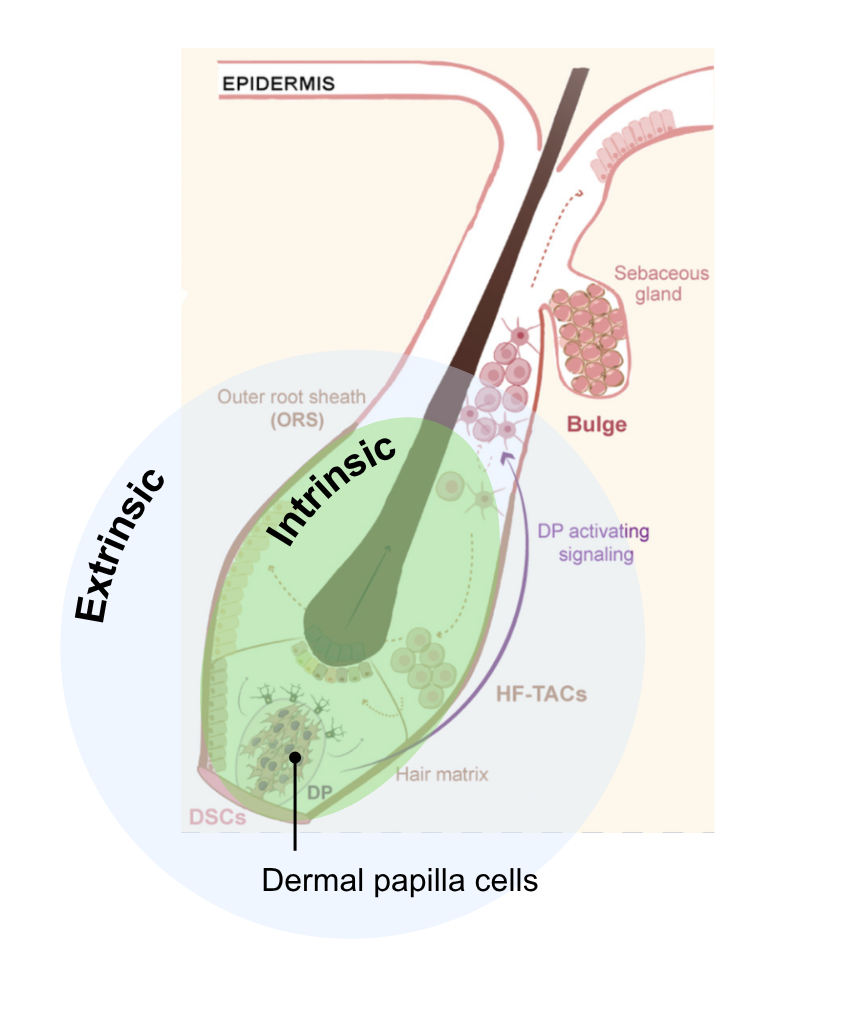
This is the gap RE:YOU / NOVOGRO™ is aiming at. Rather than repurposing an old drug, its molecules were engineered from the ground up around follicle biology: NV-1065 (a non-steroidal 5-AR / DHT inhibitor), NV-623 and NV-624 (targeting the dermal papilla cells that orchestrate growth), and NV-273, designed to prime the scalp environment for growth. That multi-pathway, environment-first design maps almost directly onto what the peri-transplant window actually needs: protect native hair from ongoing DHT pressure while optimizing the recipient environment grafts have to take root in. The clinical data is still maturing, so we keep the verdict honest below — but on biological relevance to a transplant, it is the first thing in years that isn't just old wine in a new serum bottle.

How we ranked these treatments. Products are ordered by a combination of (1) strength of clinical evidence and (2) how directly they address transplant biology — protecting native hair and optimizing graft survival. Where a treatment is elevated on biological relevance ahead of better-proven adjuncts (as RE:YOU is), we say so explicitly and keep its evidence verdict separate and honest.

The Treatments, Ranked

  1. 1 Foundation Finasteride / Dutasteride Oral Rx Supported → Details
  2. 2 Foundation Minoxidil Topical / Oral Supported → Details
  3. 3 Editor's Pick · Best New Science RE:YOU / NOVOGRO™ Engineered topical Promising → Details
  4. 4 PRP (Platelet-Rich Plasma) Procedure Partial → Details
  5. 5 KilgourMD Scalp System Scalp-care system Partial → Details
  6. 6 Ketoconazole Shampoo (2%) Topical OTC/Rx Partial → Details
  7. 7 Low-Level Laser Therapy (LLLT) Device Partial → Details
  8. 8 Nutrafol Oral nutraceutical Partial → Details
  9. 9 Vegamour (GRO) Topical serum Weak → Details
  10. 10 Exosome Therapy Procedure Investigational → Details
  11. 11 Biotin / Saw Palmetto Oral OTC Weak → Details

Full Reviews

1
Foundation Oral Prescription

Finasteride / Dutasteride

Supported
Finasteride / Dutasteride

Generic Rx · prescription required

5-AR inhibitor Lowers DHT Protects native hair Supported

Pros

  • Best evidence for preserving native (non-transplanted) hair long-term
  • Addresses the actual cause of loss — DHT-driven miniaturization
  • Reduces the amount of surrounding hair lost to progression around grafts
  • Decades of clinical use in male pattern hair loss at 1 mg/day

Cons

  • Systemic hormonal drug — sexual/mood side effects in a minority of men
  • Pregnancy category X — contraindicated in women who may become pregnant
  • Benefit stops when you stop the drug
  • Does not improve graft survival per se; it protects the surrounding field

Why It's the Foundation

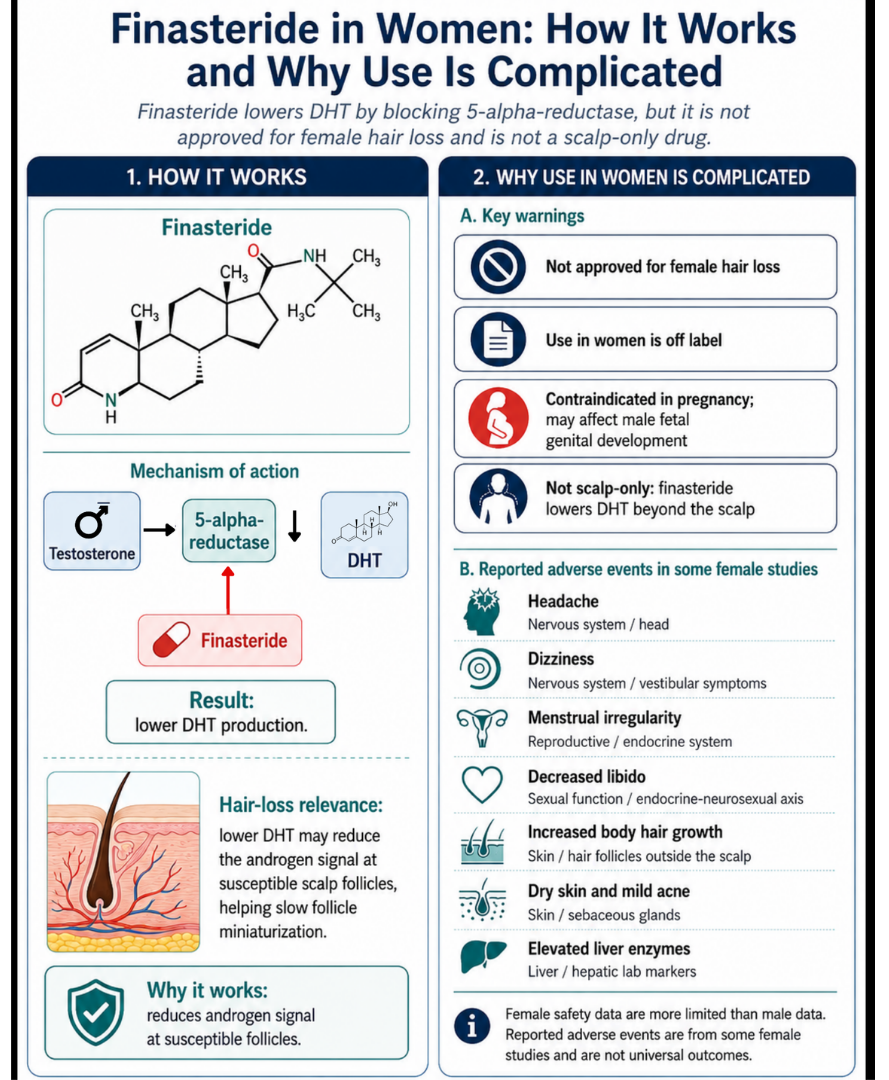
A transplant relocates DHT-resistant donor follicles, but it does nothing for the native, genetically vulnerable hair around them. Without a DHT blocker, that native hair keeps thinning — and a patient can end up with transplanted islands surrounded by continuing loss. Finasteride, an irreversible type II 5-alpha-reductase inhibitor, suppresses serum DHT roughly 65–70% within 24 hours and is the single most important tool for protecting the long-term result. Dutasteride blocks both 5-AR isoenzymes and lowers DHT further; it is used off-label with stronger suppression and a correspondingly broader side-effect discussion.

The trade-off is that this is a systemic endocrine drug, not a scalp-only intervention. In men, adverse effects include sexual dysfunction, mood changes, and gynecomastia in a minority; in women, its pregnancy category X status is the dominant safety constraint. We cover the female evidence in detail in Finasteride vs. NOVOGRO™.

Who It's Best For

Effectively every male transplant patient with ongoing pattern loss who can tolerate it — it is the backbone of protecting the result. Women only under specialist supervision with appropriate pregnancy precautions.

2
Foundation Topical / Oral

Minoxidil (Rogaine, oral low-dose)

Supported
Minoxidil Check Price →

OTC (topical) / generic Rx (oral)

Vasodilator Prolongs anagen Shortens shock-loss trough Supported

Pros

  • Helps push follicles back into the growth phase — useful against shock loss
  • Supports density in both transplanted and native hair for responders
  • Topical is OTC and inexpensive; low-dose oral is increasingly used
  • Complements finasteride via a different mechanism

Cons

  • Usually paused for ~2–4 weeks post-op — timing must be surgeon-cleared
  • Can cause an initial shedding phase as cycles reset
  • Results are modest, temporary, and dependent on continued use
  • Topical irritation; oral has systemic considerations (fluid retention, hypertrichosis)

Why It's a Foundation Agent

Minoxidil is a potassium-channel opener and vasodilator that increases perifollicular blood flow and prolongs the anagen (growth) phase, partly by upregulating VEGF in dermal papilla cells. In the transplant context its most useful property is the ability to coax shocked follicles back into growth, which can shorten and soften the shock-loss trough. Surgeons typically pause it in the immediate post-op period to avoid irritation over healing grafts, then resume it once the recipient area is cleared. We break down the mechanism and its limits in Minoxidil vs. NOVOGRO™.

Who It's Best For

Nearly all transplant patients, as the second half of the min/fin foundation. Oral low-dose is an option for those who dislike topical application, under medical supervision.

3
Editor's Pick · Best New Science Engineered topical

RE:YOU (NOVOGRO™ complex)

Promising — Clinical Pending
RE:YOU (NOVOGRO™ complex) Check Price →

Direct-to-consumer subscription

Purpose-built molecules NV-1065 · NV-273 · NV-623/624 Multi-pathway Non-hormonal design Partially Supported

Pros

  • The only option here engineered for follicle biology rather than repurposed
  • Multi-pathway: DHT (NV-1065), dermal papilla growth (NV-623/624), scalp priming (NV-273)
  • NV-273's environment-priming maps directly onto optimizing the recipient site
  • Non-steroidal, non-hormonal design; strong preclinical safety battery
  • Preclinical potency reported comparable to (or exceeding) dutasteride in model systems

Cons

  • Clinical (RCT) evidence still maturing — interim 90-day data only; 6-month pending
  • Not transplant-specific in labeling; peri-op use is extrapolation
  • Newer brand; long-term real-world data limited
  • Subscription cost

Why It's Our Pick Among the Newer Options

Everything ranked below this card is, mechanistically, a variation on ingredients that already existed. RE:YOU is the exception. The NOVOGRO™ complex is a set of molecules discovered via machine-learning screening and built specifically around hair-follicle biology: NV-1065, a non-steroidal 5-AR inhibitor that lowers DHT pressure without the systemic hormonal profile of finasteride; NV-623 and NV-624, aimed at the dermal papilla cells that orchestrate the growth cycle; and NV-273, designed to prime the scalp environment for growth. That last piece is what makes it unusually relevant to a transplant: graft survival and native-hair health both depend on the recipient-site environment, and no legacy agent was designed to optimize it.

We are deliberately keeping the evidence verdict at Partially Supported. The preclinical package — including a 3D hair-follicoid model and human enzyme assays — is stronger than what we usually see in this category, and our own editorial team independently replicated the 5-AR inhibition result. But the randomized clinical data is still coming in. The complete interim 90-day results from a 190-woman, double-blind trial against OTC minoxidil show 56% less shedding (44% better than minoxidil) and 50% greater hair count and density vs. minoxidil. The trial serum contains NV-623, NV-624 and NV-273 (not NV-1065), and it was not run in transplant patients. The trial is registered on ClinicalTrials.gov (NCT07785869) — a transparency step most cosmetic studies skip and one of the strongest signals a company-sponsored trial can offer — and the 6-month readout is pending. So we rank it high on biological relevance to a transplant while being explicit that clinical proof is not yet settled. For the full mechanistic breakdown, see our three-part series: Part 1 (Minoxidil), Part 2 (Finasteride), and Part 3 (PP405).

To be clear about categorization: because RE:YOU is sold direct-to-consumer as a topical, it is easy to lump in with the botanical serums lower on this list — but that comparison is misleading. Its NV-molecules were discovered through machine-learning screening and validated in a 3D hair-follicoid model and human enzyme assays, with a defined mechanism at each target (5-AR, dermal papilla, scalp environment) rather than a proprietary plant blend. This is an engineered topical with a real pharmacological rationale, not a fragrance-and-botanicals serum, which is why it sits here on biological relevance while its randomized clinical readouts finish maturing.

Who It's Best For

Patients who want the min/fin foundation plus a mechanistically differentiated topical aimed at the follicle environment, and who are comfortable being early adopters while the clinical data matures. Not a replacement for finasteride's proven native-hair protection.

4
In-Office Procedure

PRP (Platelet-Rich Plasma)

Partially Supported
PRP (Platelet-Rich Plasma)

In-office · ~$400–$1,000+ / session

Autologous growth factors Adjunct Mixed-positive data Partially Supported

Pros

  • Autologous — uses the patient's own platelets, low allergy risk
  • Several trials show modest density/thickness improvement in AGA
  • Sometimes used peri-operatively to support the recipient area

Cons

  • Protocols (spin, activation, frequency) are non-standardized — results vary
  • Evidence for improving graft survival specifically is limited
  • Repeated sessions; out-of-pocket cost

Where It Fits

PRP concentrates the patient's own platelet-derived growth factors and injects them into the scalp to stimulate follicles. The AGA literature is mixed but leans positive for modest density gains, and some surgeons use it as a peri-transplant adjunct. The honest caveat is heterogeneity: preparation and dosing vary widely between clinics, so published results don't transfer cleanly, and direct evidence that PRP improves graft take is thinner than the marketing implies. A reasonable adjunct for motivated patients, not a foundation.

5
Topical scalp system

KilgourMD Scalp System

Partially Supported
KilgourMD Scalp System Check Price →

DTC · serum + shampoo system

Scalp-health focus Serum + shampoo Supportive scalp care Partially Supported

Pros

  • Dermatologist-developed; emphasizes scalp barrier and a calm, low-irritation routine
  • Gentle cleansing fits the post-op scalp-care phase
  • Company reports its own clinical testing of the system

Cons

  • Not a drug — no DHT or dedicated growth-drug mechanism
  • Evidence is largely brand-run rather than independent
  • Premium price for a supportive rather than foundational role

Where It Fits

KilgourMD is a dermatologist-founded scalp-care system (a treatment serum plus gentle shampoo/conditioner) built around scalp health as the substrate for hair growth. In the transplant timeline it slots into the "calm the scalp" weeks — low-irritation cleansing and barrier support once the site is cleared. It is a reasonable supportive layer, but it is supportive scalp care, not a treatment: it doesn't replace the min/fin foundation and its evidence is mostly manufacturer-generated.

6
Topical OTC / Rx

Ketoconazole Shampoo (2%)

Partially Supported
Ketoconazole Shampoo (2%) Check Price →

OTC 1% / Rx 2%

Anti-inflammatory Mild anti-androgenic Scalp support Partially Supported

Pros

  • Reduces scalp inflammation and seborrheic dermatitis that can worsen shedding
  • Some evidence of mild local anti-androgenic effect on the follicle
  • Cheap, widely available, easy to add to a routine

Cons

  • Adjunct only — small effect size on hair density
  • Introduce only once the surgeon clears washing over grafts
  • Can be drying with frequent use

Where It Fits

Ketoconazole's primary value post-transplant is scalp hygiene: controlling inflammation and seborrheic dermatitis that create a hostile follicular environment. There is also modest evidence for a mild anti-androgenic action at the scalp. It is a sensible, low-cost supporting player once cleansing over the grafts is permitted — not a growth driver on its own.

7
At-Home Device

Low-Level Laser Therapy (LLLT)

Partially Supported
Low-Level Laser Therapy (LLLT)

Caps / combs · ~$200–$800 device

Red-light photobiomodulation FDA-cleared devices Adjunct Partially Supported

Pros

  • Several FDA-cleared devices; some RCTs show modest density gains in AGA
  • Non-invasive, no drug interactions, easy to combine with min/fin
  • Once healed, gentle enough for long-term home use

Cons

  • Effect size is modest and adherence-dependent
  • Device cost; results build slowly over months
  • No specific evidence for improving graft survival

Where It Fits

LLLT (red-light photobiomodulation) is thought to stimulate follicular activity at the mitochondrial level. The evidence base is real but modest, and several devices carry FDA clearance for AGA. As a hands-off adjunct that layers cleanly onto the foundation, it is reasonable for patients who want to do everything — just calibrate expectations and start only after the scalp has healed.

8
Oral Nutraceutical

Nutrafol

Partially Supported
Nutrafol Check Price →

~$79 / month subscription

Botanical blend Company-run RCTs Not transplant-specific Partially Supported

Pros

  • Has published randomized, placebo-controlled trials (unusual for a supplement)
  • Reported modest improvements in hair counts and quality in those trials
  • Convenient oral routine; addresses stress/inflammation-linked shedding

Cons

  • Key trials are company-sponsored with limited independent replication
  • Proprietary blend — individual ingredient doses not fully transparent
  • No DHT-blocking or transplant-specific mechanism; effect is modest
  • Ongoing subscription cost

Where It Fits

Nutrafol is the rare nutraceutical with actual randomized, placebo-controlled data behind it — e.g. Ablon 2018 in the Journal of Drugs in Dermatology — showing modest improvements in hair growth in women with self-perceived thinning. The honest framing: those trials are company-run, the effect is modest, the blend is proprietary, and none of it is transplant-specific. It is a defensible "everything else is optimized, why not" add-on, not a core part of protecting a graft.

9
Topical Serum

Vegamour (GRO)

Weak for This Use
Vegamour (GRO) Check Price →

DTC serum / supplements

Plant-based serum Marketing-heavy Minimal peer-reviewed data Weak

Pros

  • Pleasant to use; well-packaged
  • Plant-based, fragrance-conscious options for sensitive users
  • May improve the appearance of fullness temporarily

Cons

  • Little independent, peer-reviewed clinical evidence for regrowth
  • No DHT or drug-level growth mechanism — marketing outpaces data
  • Premium price for little demonstrated regrowth benefit
  • Not a substitute for anything higher on this list

Where It Fits

Vegamour's GRO serums are pleasant and heavily marketed, but the ingredients have no demonstrated mechanism to lower DHT, protect follicles, or drive regrowth, and the clinical evidence that they do is thin and largely brand-generated. For a transplant patient trying to protect a surgical investment, there is little here that can meaningfully help — it should never displace the min/fin foundation or the mechanistically stronger options above it.

10
In-Office / Investigational

Exosome Therapy

Investigational
Exosome Therapy

In-office · high cost, variable

Cell-derived vesicles Not FDA-approved for hair Thin human data Investigational

Pros

  • Biologically interesting — growth-factor-rich signaling vesicles
  • Early case series and small studies report some benefit

Cons

  • No FDA approval for hair loss; regulatory and sourcing concerns
  • Product composition is unstandardized and often opaque
  • Human evidence is thin; heavily marketed relative to proof
  • High out-of-pocket cost for an unproven benefit

Where It Fits

Exosome therapy is scientifically intriguing but clinically premature for hair restoration. It is not FDA-approved for this use, products are unstandardized, and the human evidence does not yet justify the cost or the marketing. We would not recommend it as part of a transplant regimen outside a well-run clinical trial.

11
Oral OTC Supplements

Biotin / Saw Palmetto

Weak for This Use
Biotin / Saw Palmetto

OTC · inexpensive

Popular OTC Weak evidence Can interfere with lab tests Weak

Pros

  • Inexpensive and widely available
  • Biotin genuinely helps the minority who are actually deficient
  • Saw palmetto is a mild, natural 5-AR modulator for those avoiding drugs

Cons

  • No benefit from biotin without a real deficiency
  • Saw palmetto is far weaker than finasteride with less evidence
  • High-dose biotin can distort thyroid and troponin lab assays

Where It Fits

These are the default drugstore picks, and for most transplant patients they do little. Biotin only helps if you're deficient (uncommon), and can interfere with important blood tests at high doses. Saw palmetto is a plausible but weak natural anti-androgen — a fallback for those who refuse finasteride, not a substitute for it. For a deeper look, see our review of saw palmetto for hair loss and biotin for hair growth.

Side-by-Side Comparison

Treatment Type Mechanism Post-Op Role When to Start Evidence
Finasteride / Dutasteride Oral Rx 5-AR inhibition ↓ DHT Protects native hair Continue through / resume post-op ✓ Supported
Minoxidil Topical / oral Vasodilator, prolongs anagen Blunts shock loss, density ~2–4 wks (surgeon-cleared) ✓ Supported
RE:YOU / NOVOGRO™ Engineered topical Multi-pathway; NV-273 primes scalp Follicle + environment optimization Once healed / per plan Promising — clinical pending
PRP Procedure Autologous growth factors Adjunct density support Peri-op / staged sessions Partial
KilgourMD Scalp-care system Scalp-health support Gentle scalp care Wks 2–4 (cleared) Partial
Ketoconazole 2% Topical OTC/Rx Anti-inflammatory, mild anti-androgen Scalp hygiene Wks 2–4 (cleared) Partial
LLLT Device Red-light photobiomodulation Adjunct density After healing Partial
Nutrafol Oral nutraceutical Botanical blend General support Anytime Partial
Vegamour Topical serum Plant-based blend No proven role After healing Weak
Exosomes Procedure Cell-derived vesicles Investigational Trial only Investigational
Biotin / Saw Palmetto Oral OTC Vitamin / weak anti-androgen Minimal Anytime Weak

Frequently Asked Questions

When can I start minoxidil again after a transplant?

Most surgeons pause minoxidil for roughly the first two to four weeks so it doesn't irritate healing grafts, then have patients resume once the recipient area is cleared. Timing varies by surgeon and technique — always follow your own surgeon's instructions rather than a general rule. Some clinicians prefer oral low-dose minoxidil post-op to avoid topical contact with the grafts entirely.

Is shock loss permanent?

Usually not. Shock loss is a temporary, stress-induced shedding (a form of acute telogen effluvium) that typically bottoms out around months 3–4 and then recovers as follicles re-enter the growth phase. Transplanted grafts regrow and most shocked native hairs return. The exception is native hair that was already severely miniaturized and near the end of its life — some of that may not fully recover, which is exactly why protecting native hair with finasteride matters.

Do I still need finasteride after a transplant?

For most men, yes. A transplant moves DHT-resistant donor follicles, but it doesn't stop the native, genetically vulnerable hair around the grafts from continuing to thin. Without a DHT blocker, you can end up with transplanted density surrounded by ongoing loss. Finasteride is the single most important agent for protecting the long-term result. Women should only use it under specialist supervision with pregnancy precautions.

Does PRP improve graft survival?

The evidence is mixed-but-encouraging for modest density improvement in androgenetic alopecia, and some surgeons use PRP peri-operatively. Direct proof that it improves graft take specifically is limited, and PRP protocols are not standardized, so results vary between clinics. It's a reasonable adjunct for motivated patients, not a foundation.

Can I use scalp serums like RE:YOU or KilgourMD after a transplant?

Generally yes, but only once your surgeon clears topical products over the recipient area — applying anything to fresh grafts risks irritation and dislodging. RE:YOU (NOVOGRO™) is the more mechanistically interesting of the two because its molecules, including NV-273, are designed to optimize the follicle and scalp environment; its clinical data is still maturing. KilgourMD is a supportive scalp-health system that fits the gentle-cleansing phase. Neither replaces the minoxidil-plus-finasteride foundation.

How long until I see the final result?

Expect the timeline to be slow. After the initial shedding, transplanted hairs begin regrowing around months 3–4, fill in through months 6–12, and the final result is typically assessed at 12–18 months. Consistency with your regimen during that whole window — not any single product — is what determines how good the result looks at the end.


References & Further Reading